












Most articles about Google Forms alternatives spend a lot of time making Google Forms look bad. This one won’t do that.
Google Forms is genuinely good at what it does. It’s free, it’s fast to set up, and for straightforward data collection—a signup form, an internal survey, a quick poll—it’s hard to argue with. The problem isn’t that it’s a bad tool. The problem is that it’s a specific tool, designed for a specific job, and a lot of people are trying to use it for jobs it wasn’t built for.
This guide is about recognizing when you’ve hit that ceiling. Not through a feature checklist, but through the actual situations where Google Forms stops working the way you need it to.
What we’ll cover:
- The signs you’ve outgrown Google Forms
- Scenario 1: You need a document, not a spreadsheet row
- Scenario 2: You’re collecting signatures
- Scenario 3: Different people need to fill in different things
- Scenario 4: Submissions need to go to different people
- Scenario 5: You need to collect payment at the same time
- Scenario 6: You have an existing PDF form
- What Google Forms is still the right tool for
- If you decide to switch
The Signs You’ve Outgrown Google Forms
A quick self-check. If any of these sound familiar, keep reading:
- Someone submitted your form and you spent time manually copying their information into another document
- You sent a follow-up email to collect a signature that should have been part of the form
- A submission went to the wrong person’s inbox and sat there for days
- You built a separate payment link and had to manually match payments to form responses
- Your form collected information that didn’t apply to half the respondents, and you’re now filtering it out of a spreadsheet
- You’ve said “I wish Google Forms could just…” at least once
None of these are catastrophic on their own. But they all point to the same underlying issue: Google Forms treats every submission as a data row, when what you actually need is a workflow.
One thing worth knowing before you read further: if you do decide to switch, you don’t have to rebuild your existing Google Forms from scratch. PlatoForms has a direct import—connect your Google account, paste the form’s edit URL, and it opens in the PlatoForms editor with your questions, sections, and field types already mapped. The switching cost is lower than it probably sounds.
Scenario 1: You Need a Document, Not a Spreadsheet Row
Google Forms is built around data collection. The output is a spreadsheet. If your process ends with “the data is in Sheets,” it works perfectly.
But a lot of processes don’t end there. They end with a document—a confirmation, an invoice, a signed agreement, a case summary, a receipt. Turning a spreadsheet row into a formatted document requires manual work, or a chain of add-ons, or an Apps Script that someone has to maintain every time a field name changes.
What a different approach looks like: A form where every submission automatically generates a formatted PDF. The document pulls from the submission data—name, date, selected options, calculated totals—and delivers itself without anyone touching it.

If you have an existing PDF (a contract, a waiver, an application), you convert it to an online form that fills in the original layout automatically on submission. If you don’t have an existing PDF, PDF Templates let you design the output from inside the form builder—add static text, dynamic variables, headers, margins—and every submission generates it.
The chain becomes: form submitted → PDF generated → sent automatically. No intermediate steps, no manual export.
Scenario 2: You’re Collecting Signatures
Google Forms has no signature field. This is a hard limit—there’s no setting to enable, no workaround that doesn’t involve sending a separate document afterward.
The typical fix is a two-step process: collect information via the form, then send a separate PDF or e-sign link for the signature. This creates two things to track, two completion rates, and two points where something can go wrong. A checkbox can show agreement and may qualify as an electronic signature in some circumstances, but Google Forms does not provide the signing evidence and document verification that a dedicated signature process can record.
What a different approach looks like: A signature field built into the form itself—at the end of the same flow where respondents filled in their information. They sign with a finger on mobile or a mouse on desktop. When the form is sent through a tracked invitation or workflow step with the signature certificate turned on, PlatoForms records the consent notice, signer details, signed PDF fingerprint and event timeline. One flow, one record.
Scenario 3: Different People Need to Fill In Different Things
Google Forms supports section branching—sending respondents to different sections based on a single answer. It works for basic skip logic. But it doesn’t support field-level conditional rules, multi-condition logic, or showing and hiding individual fields within a section.
The result is usually one of two things: a form that asks everyone every question (including the ones that don’t apply), or multiple separate forms for different audiences, each with its own submission stream to manage.
What a different approach looks like: Conditional logic applied at the individual field level. A single form that adapts as the respondent fills it in—showing only what’s relevant to their specific situation. A client intake form that surfaces personal injury fields for some clients and estate planning fields for others. A registration form that shows accommodation options only to multi-day attendees.
You can write the rule in plain English—“show the medical information section only if the participant answers yes to physical activity”—and Gen by AI generates the logic configuration for you.
This also extends to the generated PDF: fields that don’t apply to a particular respondent can be hidden from the document output automatically, so the PDF reflects their actual situation rather than the full form inventory.
Scenario 4: Submissions Need to Go to Different People
Google Forms sends every submission notification to the same place. One inbox, all responses mixed together. If your form serves multiple departments, teams, or request types, someone has to sort it—and important things get delayed or missed.
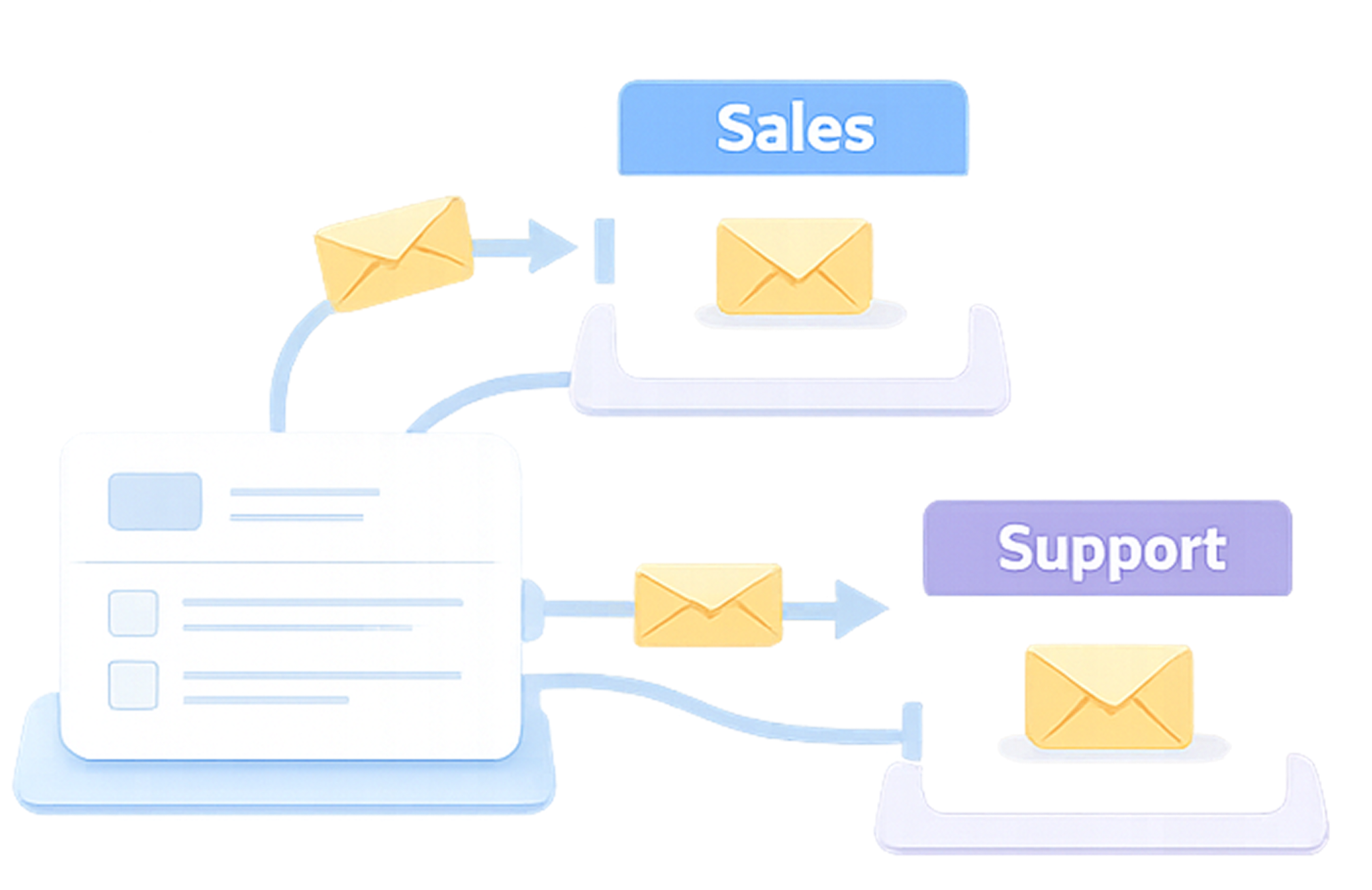
The typical fix is a Google Apps Script that routes notifications based on field values. It works, but creates a maintenance dependency: every time you rename a field, add a new option, or change a recipient, the script needs to be updated. Reordering questions can silently break it with no error message.
What a different approach looks like: Routing rules built directly into the form. A pickup order goes to shop staff; a delivery order goes to the courier. A full-time job application goes to the hiring manager; an internship application goes to the team lead. Each rule is set through a visual interface—or described in plain language and generated by AI—and updating it takes a few clicks rather than a code edit.
See how logic-based email routing works →
Scenario 5: You Need to Collect Payment at the Same Time
Google Forms has no payment integration. If your form is for a paid event, a product order, or a service deposit, payment has to happen elsewhere—a separate link, a separate checkout, a separate record to reconcile against your form submissions.
The friction compounds with volume: some people complete the form but don’t pay; some pay but don’t complete the form. Matching the two sets of records requires manual effort. The more submissions you process, the worse it gets.
What a different approach looks like: A payment field inside the form. Respondents enter card details—or tap Apple Pay or Google Pay—at the point of submission. The payment and form data arrive together, already matched. You can set a fixed amount or calculate it dynamically based on what the respondent selected: number of tickets × price, product variant × quantity, or any other formula.
How Stripe integration works →
Scenario 6: You Have an Existing PDF Form
If your organization has been using PDF forms for years—signed paper forms, fillable Acrobat files, compliance documents with approved layouts—Google Forms doesn’t help you transition. It can’t import a PDF, can’t preserve the layout, and can’t generate output that looks like the original document.
The usual path is rebuilding from scratch: a new layout, a new review process, and the risk that the new form doesn’t satisfy the same compliance requirements as the one it replaced.
What a different approach looks like: Upload the PDF and let AI Field Recognition detect the fields automatically—names, checkboxes, dropdowns, signature lines—and map them to an online form that preserves the original structure. If you want a web form version, Clone Form converts a PDF form to a browser-native layout in one step, with compatible fields carrying over automatically.
You already have a Google Form you want to bring over? Import it directly—paste the edit URL, and the form opens in the PlatoForms editor with your questions, sections, and field types already mapped.
What Google Forms Is Still the Right Tool For

Being honest here matters. Google Forms is the right choice when:
- You’re collecting simple information with no downstream document requirement
- Everyone involved is in Google Workspace and the Sheets integration is genuinely useful for your workflow
- The form is internal-only and branding doesn’t matter
- You need something live in the next fifteen minutes and these scenarios don’t apply to you
If that describes your situation, there’s no reason to switch. The best tool is the one that fits the job—and for a lot of jobs, Google Forms fits.
If You Decide to Switch
The fastest paths in, depending on where you’re starting:
| Your starting point | Best path |
|---|---|
| Existing Google Forms | Import directly — paste the URL, done |
| Existing PDF forms | AI Field Recognition or Clone Form |
| Starting from scratch | AI Form Generator or 2,000+ templates |
The free plan covers enough to build a complete form and see how the full submission workflow runs end to end—no credit card required.
Related Reading
- Logic-Based Email Routing: When One Notification Isn’t Enough
- How to Collect Payments with Google Forms
- Google Forms Conditional Logic: How It Works and Its Limitations
- Google Forms AI (Gemini): What It Can and Can’t Do
Try PlatoForms with Your Own Form
Turn an existing PDF into an online form, or create a new form for your team.
Create your free PlatoForms account →


