










Find trending topics and quick answers here
Hi, how can we help?
Search by task, feature, or problem - not just a single keyword.
How to distinguish and use ‘Form Settings’ and ‘Form Default Settings’

Question
Can we simplify customizations like “Thank-you message” and “Show Edit Submission” for all our forms to save time when creating new ones?
Answer
Absolutely! PlatoForms offers two helpful features: “Form Settings” and “Form Default Settings.” Here’s the difference:
Form Settings vs. Form Default Settings
-
Form Settings: Customize specific options like “Thank-you message” or “Show Edit Submission” for individual forms. These changes only affect the chosen form.
For details, check the Manage form settings section in the User Documentation.
-
Form Default Settings: These are global preferences that apply to your entire team and impact all future forms. Any changes here affect newly created forms exclusively, ensuring consistent settings for your team.
In a nutshell, Form Settings are for individual form tweaks, while Form Default Settings are for setting global defaults that apply to all new forms.
Next, we will explain how to access and configure Form Default Settings.
Access Form Default Settings
-
Go to the Dashboard.
-
On the top of the left navigation, click your team name and click Form Default Settings.
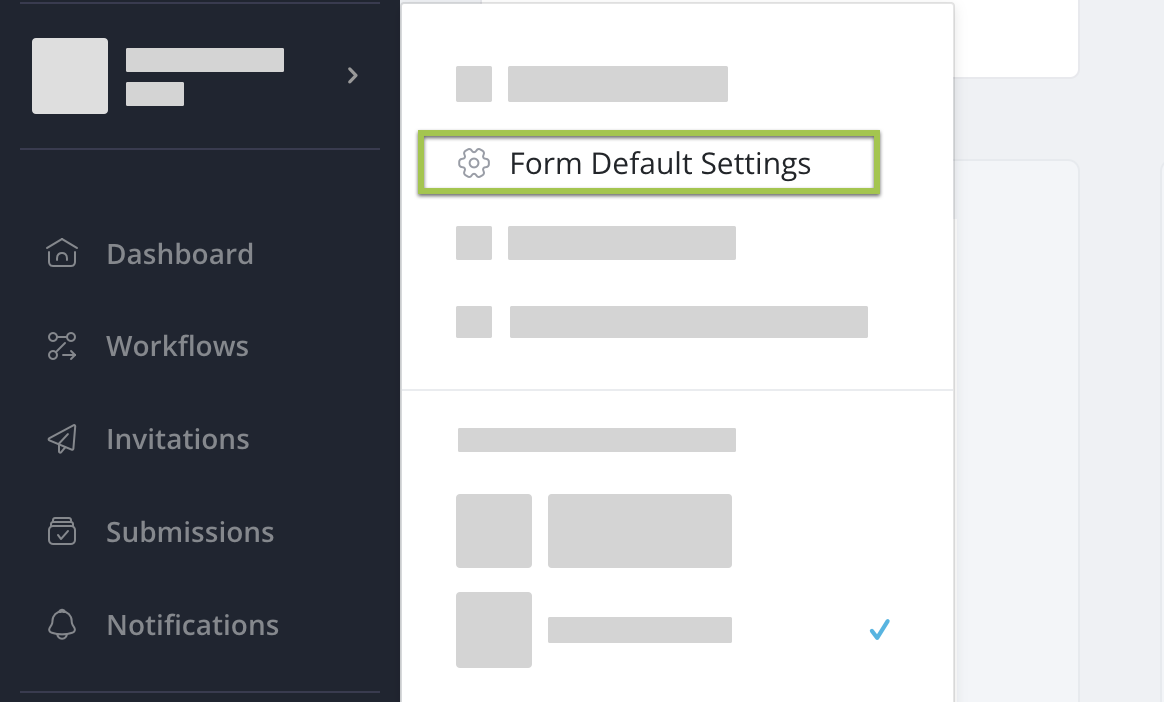
This will open the Form Default Settings window.
Manage Form Default Settings
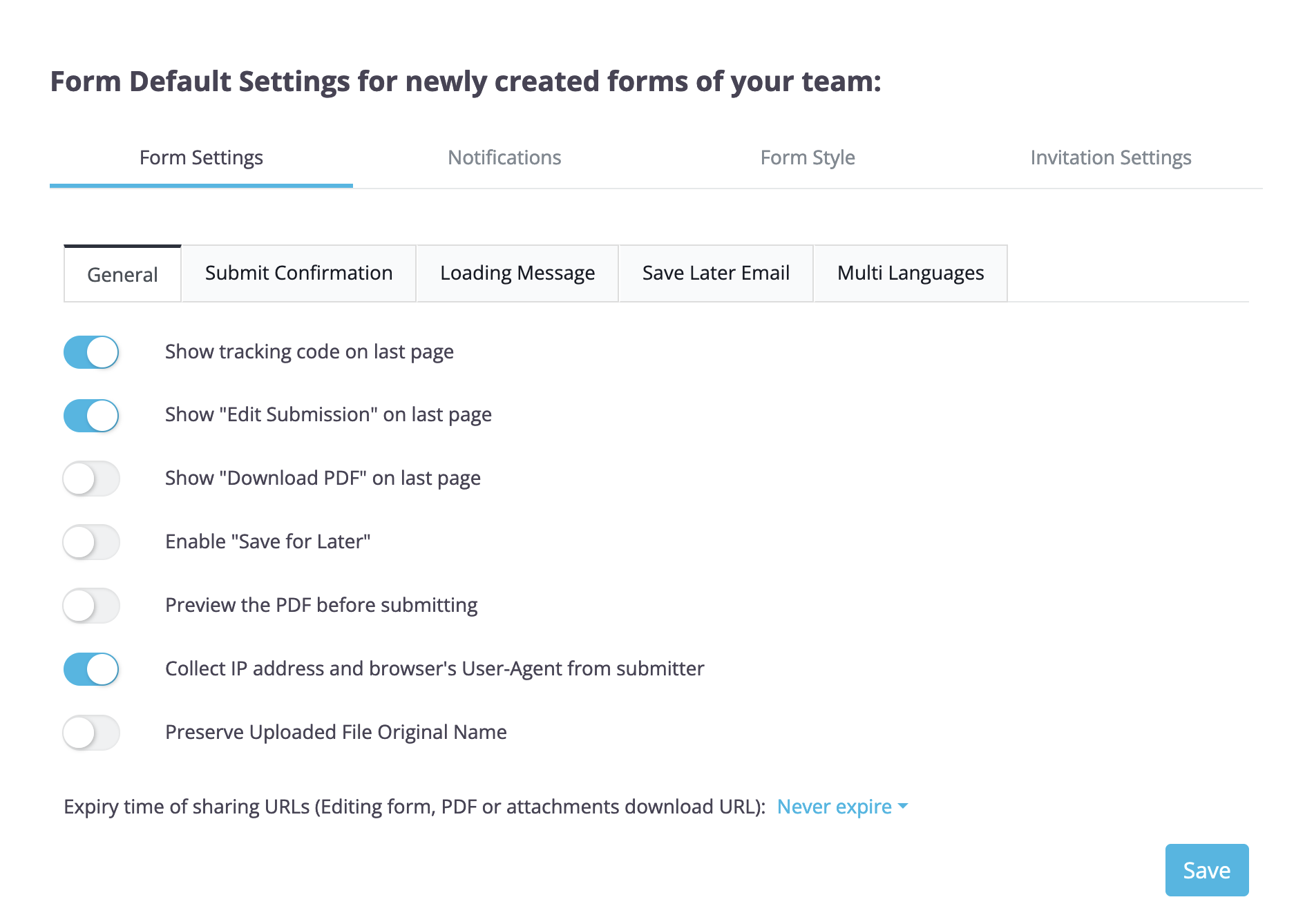
On the Form Default Settings page, the sections are listed on the left. Each section has its own Save button at the top right, so save a section before you move to the next one. Option Lists has no section Save: each list is saved on its own, updates the drafts of forms that use it, and updates published forms only when you choose to. Everyone in the team can read the defaults; saving them is for the Team Admin and members with Form permissions & defaults management.
-
General: the switches for the thank-you page (tracking code, Edit Submission, Download PDF), PDF preview before submitting, IP address and User-Agent collection, original names of uploaded files and the submission time zone, plus the expiry and passcode of shared URLs, the expiry of workflow links, and Save for Later.
-
Thank-you page: the default thank-you message, or a redirect link, and extra thank-you pages that form logic can choose.
-
Save Later Email: the subject and body of the save-for-later email.
-
Multi Languages: whether forms show the language switcher and detect the user’s language.
-
Notifications
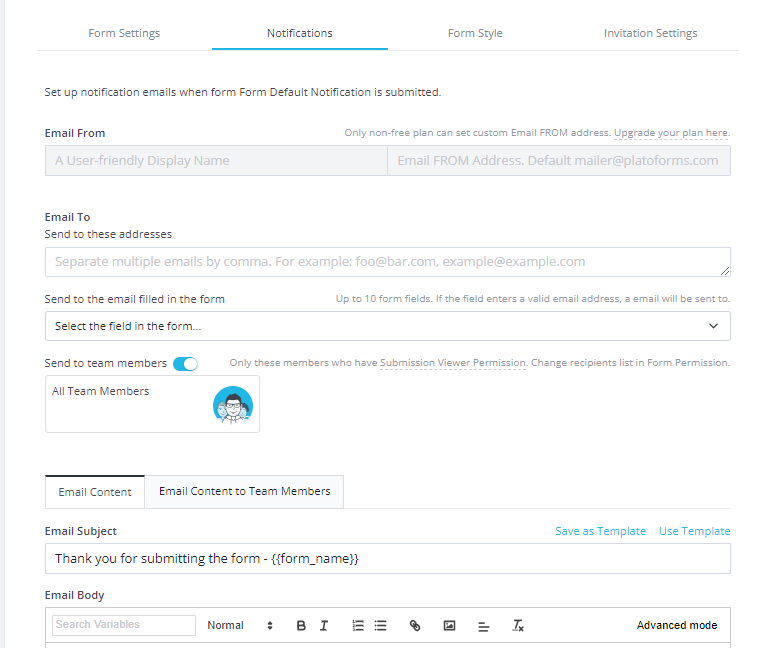
Edit the recipients, email subject, and content of email notifications for all of your future forms. For details, check the Configure form notifications section.
-
Invitation Settings
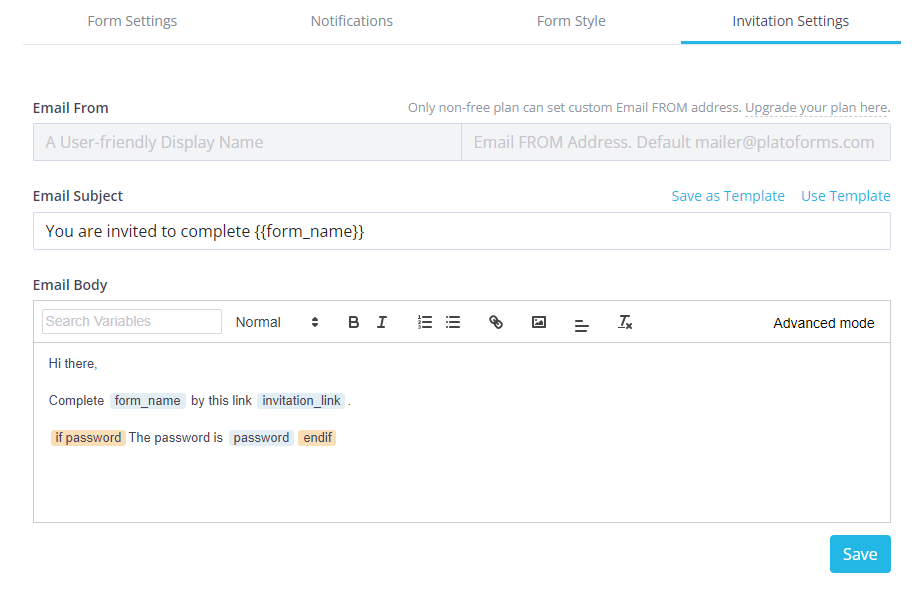
Set the starting Tracking Invitation and Signature Certificate switches, the Email From, and the email subject and content of each new invitation. Recipients are chosen in each invitation. For details, check the Use form invitation section.
-
Form Style
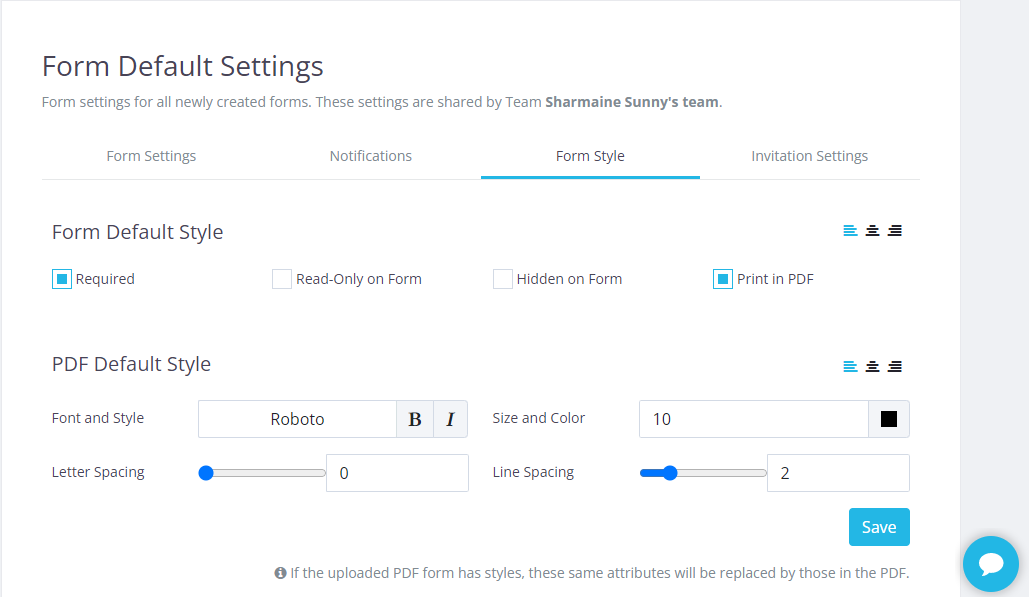
Set the default field style and the text style of generated PDFs, and they will take effect each time you create new forms.
-
Option Lists: dropdown option lists shared by the whole team.
-
Permissions: the default editors, submitters and submission viewers of new forms. This section is shown only to the Team Admin and members with Form permissions & defaults management.