August 15, 2017
Improvement of form usability
With our form builder you can create a form easily. But this is far from enough if you just simply append various input widgets into a form. Here we introduce some tips to improve the usability of your form, which will help your customers complete it more efficiently. This also makes your collected data more accurate.
Use a different sub-type for Single Text
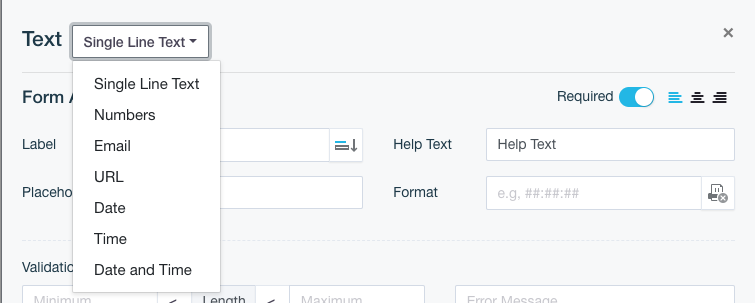
In a single line text input dialogue, you can choose the sub-type, e.g. number, email, date, date and time, URL, etc. Once you choose the sub-type, the input text is restricted to this particular type. For example, if you want to ask for the user’s email, the email sub-type will ensure that only the email addresses are accepted.
Single Choice Vs. Multiple Choice
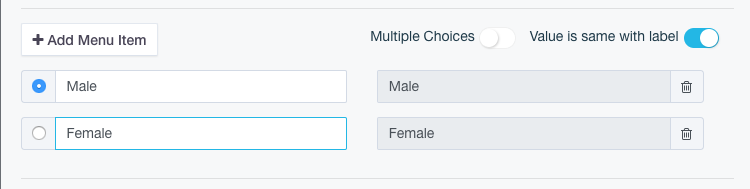
If your PDF has options, the Choice widget is made just for that purpose. Depending on your requirements, you can set it as single or multiple choices. For example, in a car sale contract PDF there are two options: a one-month warranty or a three-month warranty. Obviously, the customer can only choose one of them. In this case, Single Choice is definitely the correct choice. You simply add the choice item – i.e. 1-month warranty and 3-month warranty – and turn off Multiple Choice. After that, your form only accepts users making one choice from the warranty options.

Use Dropdown
You can use the most common scenarios for the dropdown options, for instance if the text input is Gender, City, Language, etc. which have only limited selections and you want the PDF to have consistent text. For example, you may put Female or Male as dropdown options in the gender box. If the form uses single line text, you may get various different inputs, such as, man, woman, boy, etc. That may be harder to work with as data and not what you were wanting..
Required Or Optional
All form widgets have this option. They automatically default to YES, meaning that your customer must fill in the field. However, in some cases, you may consider turning this off to make the field optional.

Add Validations
In Multiple Line Text or Single Line Text, you can add some validations to restrict user input. The most common case is maximum or minimum length. This helps you to control what the user inputs in line with your expectations. We will give more details about validation in the next blog post.

You can find more details in Field Properties.
August 10, 2017
Export Form Submissions
Whenever a customer submits a form, you’ll receive an email with the generated PDF. You can also review submission data, download PDFs, or re-generate them anytime from the Submissions page — and now, you can export all submission data as well.
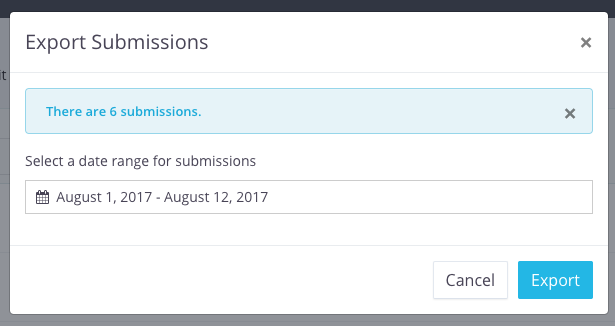
To export, simply click Export Submissions and choose a date range. Before downloading, the system will show how many submissions fall within that range. Click Export, and a ZIP file will download within seconds.
The ZIP file contains one or more CSV files. If your form has multiple revisions (for example, if you published updated versions over time), each revision will have its own CSV file. Every CSV includes the raw submission data, including the generated PDF URLs — making it a simple alternative to using the API for importing data into your own system.
You can open CSV files with any text editor, Excel, or macOS Numbers.
For more details, see Export Form Submissions.
July 31, 2017
Web form designer
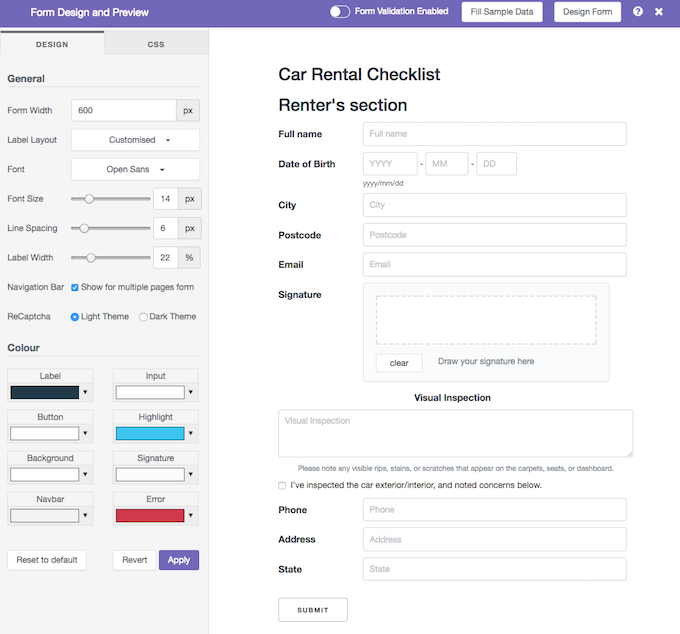
We’re pleased to announce the release of our Form Designer! With this feature, you can easily customise your form’s colours, fonts, sizes, layout, and more. It also supports embedded CSS if you want full control over your form’s look and feel.
To access it, open the Form Builder and click Preview Form on the top bar. In the preview window, select Form Design in the top-right corner. The designer appears as a sidebar on the left, and any changes you make are instantly reflected in the live preview. When you’re happy with the new design, click Apply to save it. Existing published forms won’t change until you republish, so you can refine the design safely without affecting your users.
The Form Designer has two tabs:
- Design — covers most layout and styling needs.
- CSS — for advanced customisation by adding your own stylesheet. CSS applied here overrides default styles.
For more details, see our full guide on the Form Designer.
July 28, 2017
Checkbox Vs. Radio Button
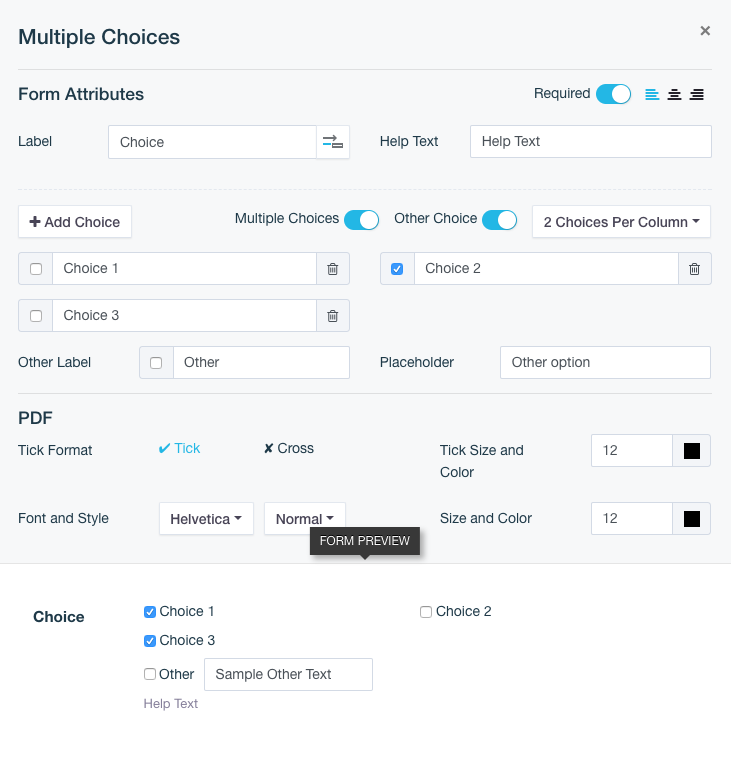
In a PDF, you usually need a tick or cross to mark selections. Choice is the proper widget to fit in. There are two kinds of Choice: one is Checkbox, which allows multiple selections, and the other is Radio Button, which allows only one selection. From its properties dialogue, you can turn on/off the Multiple Choices option to switch between easily.
Press Add Choice to add more items. Each item has a draggable square widget in the right-hand side PDF panel, just drag it to the proper location in your PDF. In the web form, each Choice item has a different label to tell what this option is for. Once it is selected in the web form, a tick or cross is rendered into your PDF at the location you dragged.
With the Other Choice option you can add a text box in the web form, which is rendered as text in your PDF.
For more details, please check out Choice Properties.
July 23, 2017
Clone a form
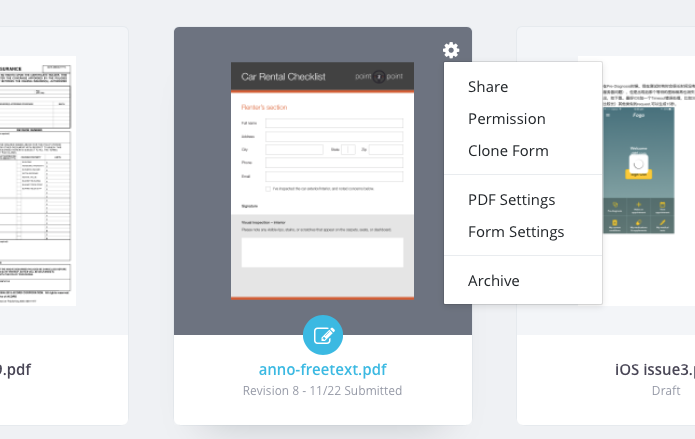
Save time on form creation! The “Clone” function duplicates existing forms effortlessly, allowing you to make minor changes like adding or removing fields or adjusting the layout without starting from scratch.
Once cloned, your new form inherits all fields, logic, and settings from the original. Need to add a new Text Input field? Simply insert it in the form builder, drag it to the right spot in the PDF, and effortlessly publish the updated version. Form editing made easy!
For more details, please check our user documentation.
July 16, 2017
Preview with sample data
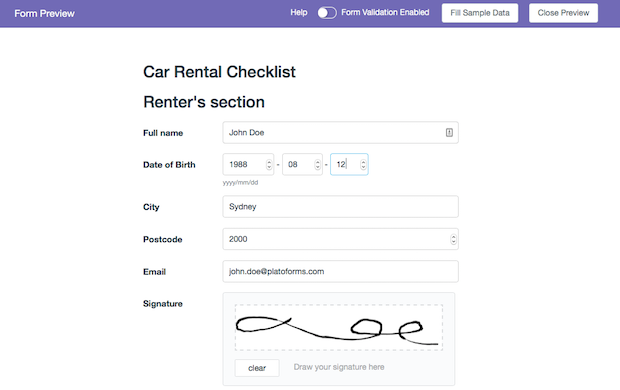
We’re excited to introduce a time-saving feature in our Form Builder! Now you can effortlessly streamline your preview process by prefilling specific fields with sample data.
For example, when building a form, inputting “John Joe” into the “Text Input” field for the name allows you to automatically fill that field with just one click of the Fill Preview Data button during the form preview. This not only enhances efficiency but also facilitates the swift preview of generated PDFs after form submissions.
Your pre-set sample data seamlessly integrates into the PDF preview when you click Preview PDF, providing a comprehensive snapshot of the submitted information.
Please note that certain fields, such as File Upload or ReCaptcha, require manual completion and cannot be pre-filled.
For more detailed instructions and insights, refer to our user documentation. Upgrade your form-building experience today!
June 1, 2017
Introduce API Version 1
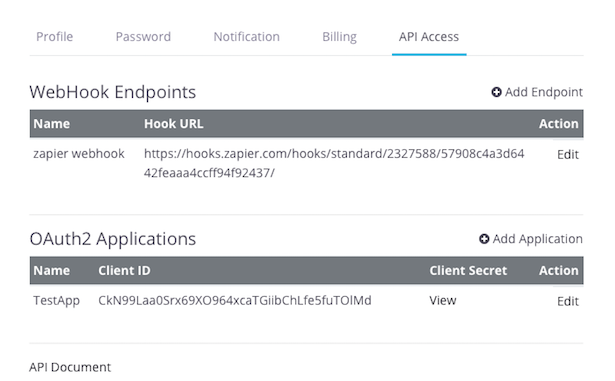
Say hello to our first-ever PlatoForms API—designed to help you access your data effortlessly and automate workflows with ease.
✨ Highlights:
-
Easy Data Access: Retrieve form details and submission data programmatically with simple API calls.
-
Real-time Webhooks: Get instant notifications whenever a form is submitted, including direct PDF links.
-
Secure OAuth2 Authentication: Protect your data with OAuth2. Generate your Client ID and Client Secret right from your dashboard.
-
Customizable Webhook Events: Monitor submission events and tailor Webhook behavior based on your needs.
-
Clear Documentation: Visit our API documentation for detailed guides and examples.
-
Available on All Plans: API and Webhook access are included in every plans — with volume limits depending on your subscription tier.
-
Free for Trial Users: Even trial accounts can start using the API and Webhooks at no extra cost.
Want to learn more about OAuth2? Check out this helpful introduction.