
Design web PDF form
Tabs
Use Preview & Design to customize how your Web PDF Form looks. You can:
- Apply a theme and preview it immediately.
- Add a logo and customize colors, fonts, spacing, and layout.
- Save your design as a shared team theme or update an existing one.
- Use custom CSS or JavaScript for advanced changes.
Access the form designer
-
Open your existing web PDF form from the Dashboard.
-
Click the Preview & Design button in the form builder at the top left.

This opens a preview where you can adjust your form’s design.
Apply a theme
Themes let you quickly change your form’s overall appearance.
-
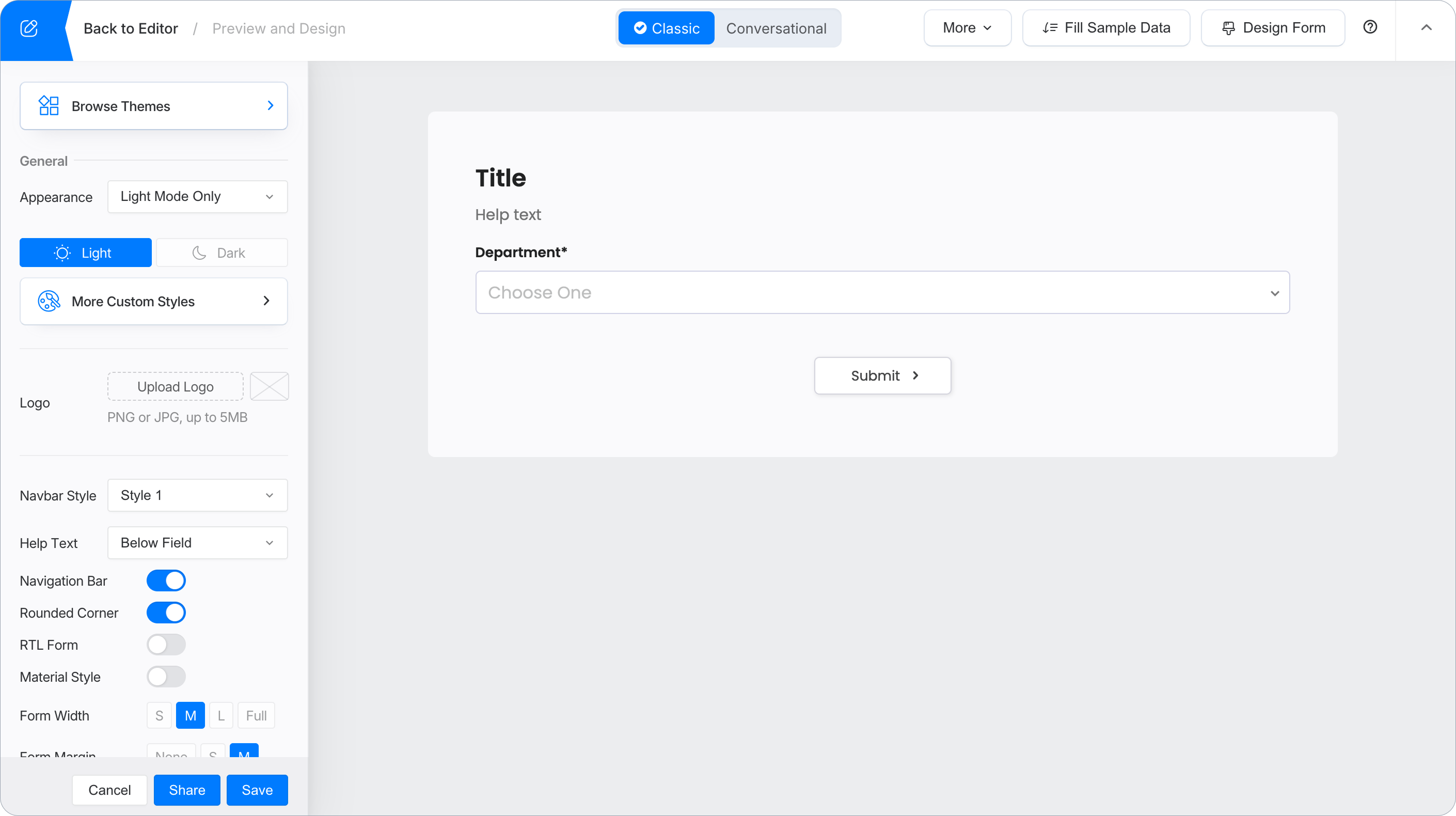
In Preview & Design, click Design Form in the top-right corner.

-
In the panel on the left, click Browse Themes.
-
Choose a theme. The preview on the right updates immediately.
Save a design as a shared form theme
Save your current design as a new theme that other members of your team can use.
-
In Preview & Design, click Design Form and customize the form.
-
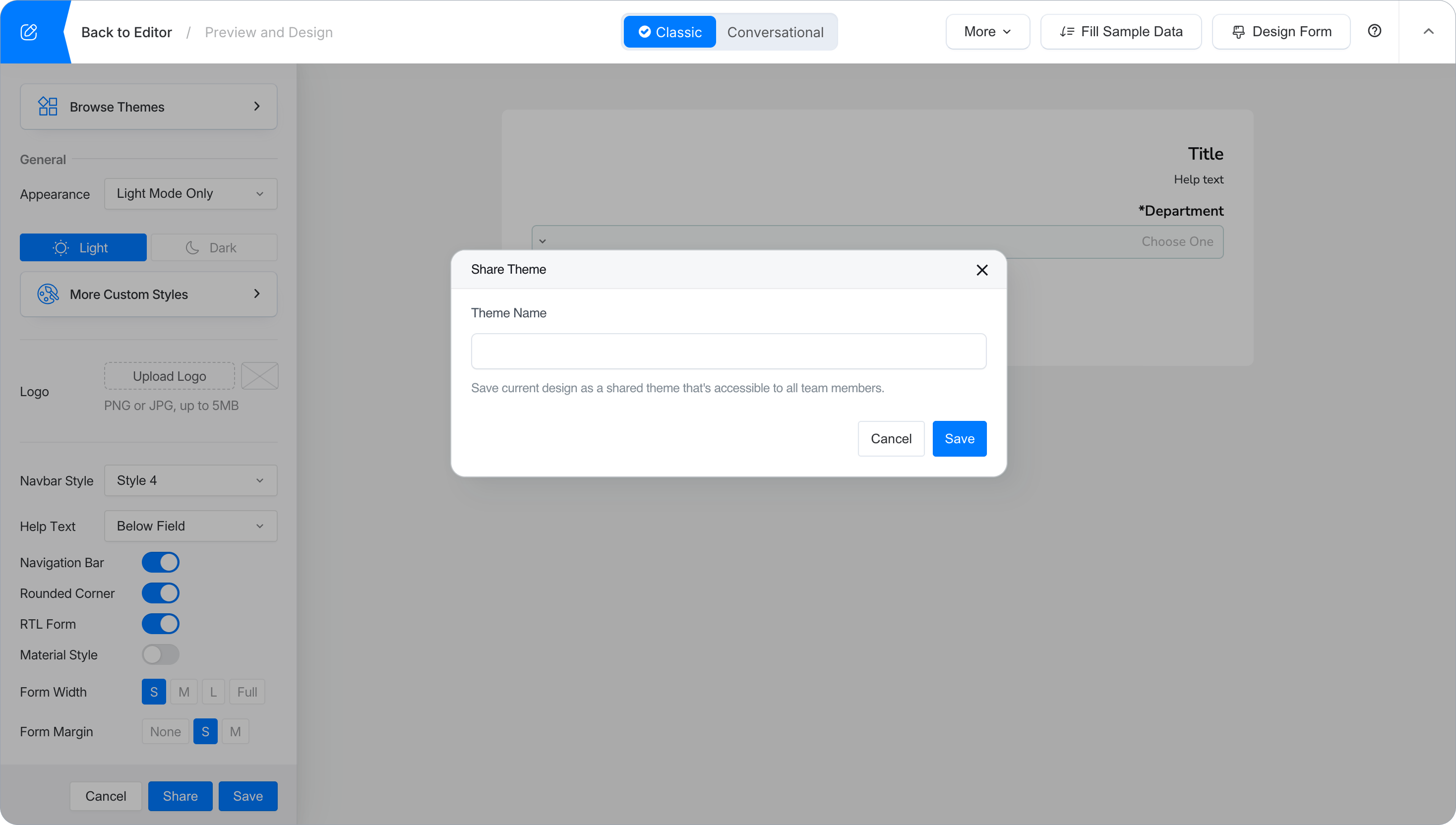
At the bottom of the panel on the left, click Share.
-
In the Share Theme dialog, enter a Theme Name, then click Save.
The new shared theme appears in Browse Themes.
Update or delete a shared theme
Use the controls on a shared theme’s card to update or delete it.
-
In Design Form, click Browse Themes.
-
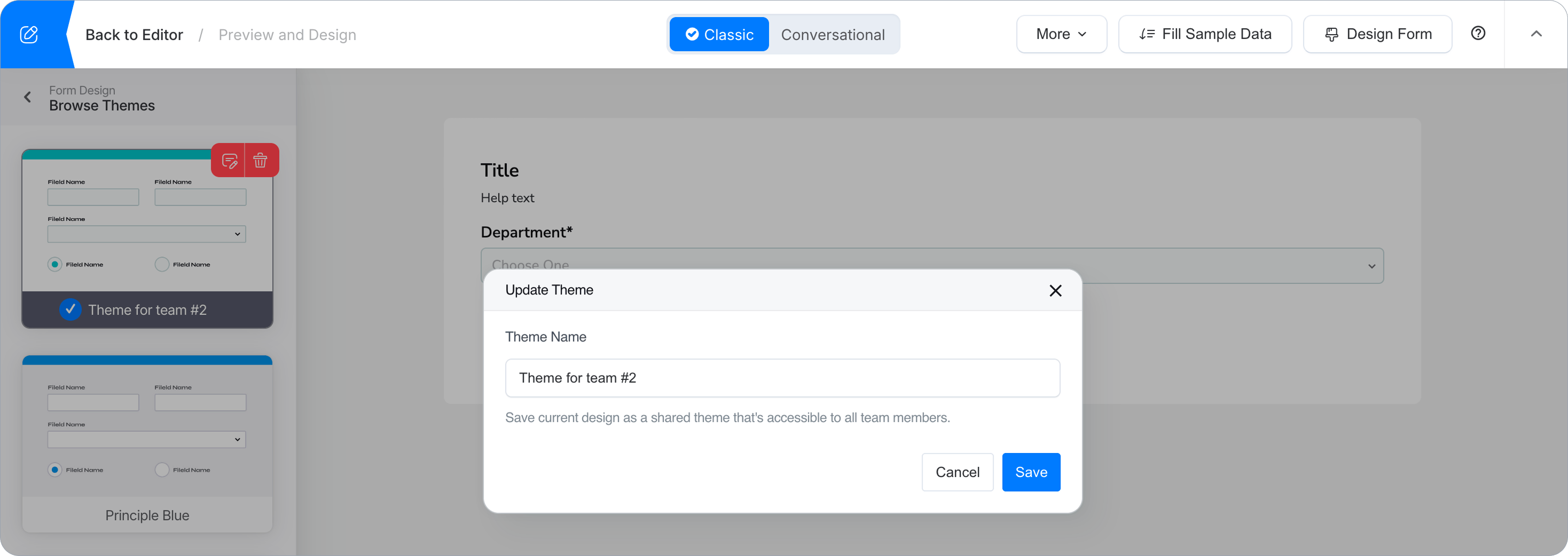
Find the shared theme and click its red edit icon.
-
Change the Theme Name if needed, then click Save. This updates the shared theme with the form’s current design.
To delete a shared theme, click the red trash icon on its card and confirm the deletion.
Customize the form design
You can also make more customizations to the form styles. All changes are instantly previewed.
-
In Preview & Design, click Design Form in the top-right corner.
-
Modify the design as needed.
NoteLearn about available customization options in the Form design properties section.
-
After making your desired modifications, click Save to apply your changes.
Form design properties
| Property | Description |
|---|---|
| Appearance | Customize the form’s visual theme:
|
| Logo | Upload a PNG or JPG (max 10MB) to display a logo on the form.
|
| Navigation Bar | If your form has multiple pages, enabling the navigation bar adds a top menu, allowing users to switch between pages. Note: To add pages, insert a Page Break when designing your form. |
| Navbar Style | Once the Navigation Bar is enabled, select a style that matches your form’s design. Options may include Tabs, Progress Bar, or Sidebar Navigation. |
| Help Text | If you’ve added help text for form fields, choose where it appears:
|
| RTL Form | Displays the form in a right-to-left layout, suitable for languages such as Arabic, Hebrew, and Persian. This setting affects text alignment and overall form direction. |
| Rounded Corner | Adds rounded corners to the form’s elements for a smoother, modern appearance. |
| Material Style | Uses a minimalistic straight-line design for input fields, similar to Material Design. |
| Form Width | Adjusts the overall width of the form. Options include:
|
| Form Margin | Sets spacing around the form’s edges. Options include:
|
| Font | Use the system default font or upload a custom font to match your brand’s identity. |
| Font Size | Adjust the text size to ensure readability. Available sizes range from Small to Extra Large. |
| Line Spacing | Controls spacing between lines of text. Options: XS, S, M, L, or XL for optimal readability. |
| Label Layout | Defines the arrangement of labels relative to input fields. If Customized is selected, return to each field’s Properties panel to adjust individual label positions. |
| Label Width | Specifies the width of field labels to ensure consistent alignment across form elements. |
More Custom Styles
You can further customize your form’s appearance and behavior using the More Custom Styles feature.
-
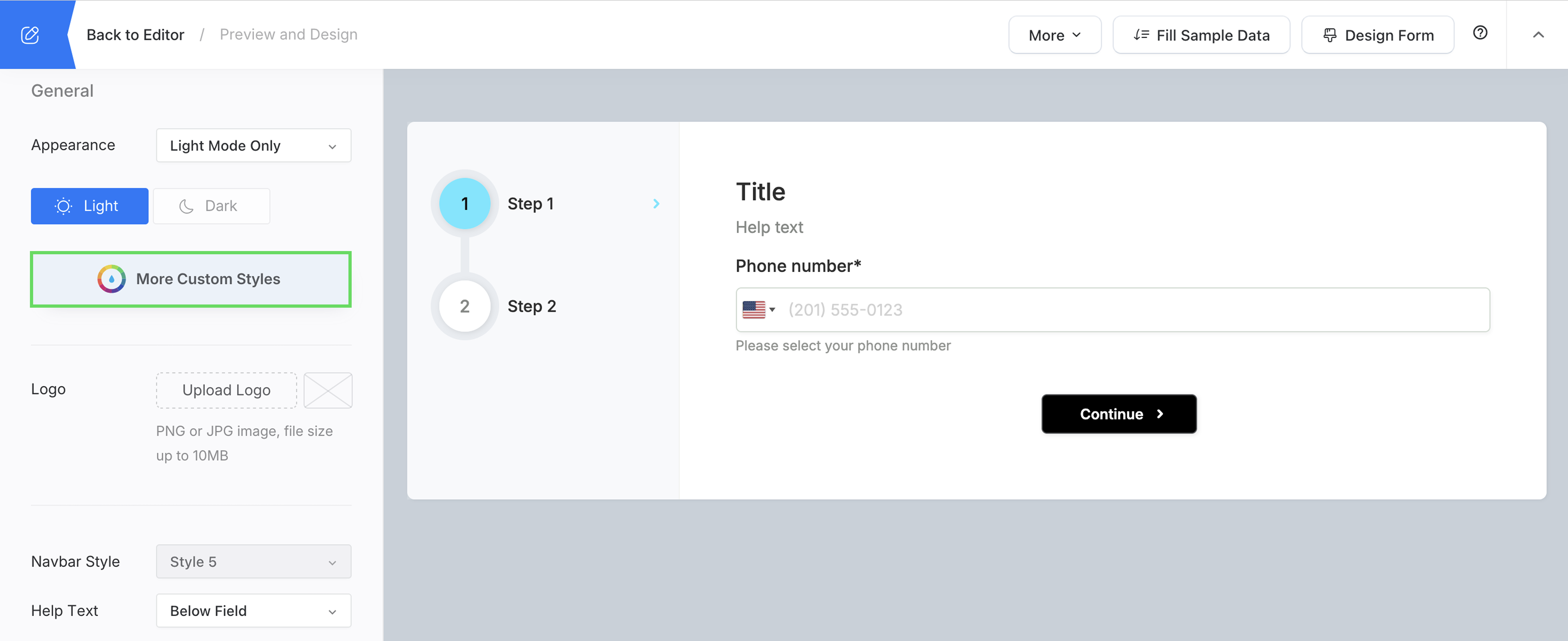
Click on the More Custom Styles button in the form editor.
-
Choose from three customization options:
- Design tab: Change background images, adjust banner size, and modify layout elements.
- CSS tab: Add custom CSS to style fonts, colors, and spacing.
- JS tab: Use JavaScript to customize labels, add logic, and control form behavior.
NoteJavaScript is secure and only works with custom domains to maintain security.
-
After making adjustments, click Save to apply your changes.
Video tutorial
Rather watch than read? We’ve got you covered with this video guide.