










Manage permissions
On this page
In PlatoForms, permissions are set per form, so a team member can have different access to different forms. This page shows how a form’s Editor sets them for one form, and how a Team Admin manages them across every form on the team.
Our API also follows these permission settings. For instance, the Form Submission Viewer permission is required for authentication when using the Get Submission Detail API request.
Introduce permissions
As a team member with Form Editor access, you can manage each member’s permissions for that specific form. Permission settings are available for individual forms only. Bulk setting is not supported from this view. An editor who is not the Team Admin and has no Form permissions & defaults management access cannot give themselves Form Submitter or Form Submission Viewer access they do not already have (“You can’t grant yourself access to submissions - ask the team owner or a permission manager.”).
There are three types of permissions for each form:
| Permission | What it controls | Who can be assigned |
|---|---|---|
| Form Editor | Can edit the form layout, fields, and settings | Specific members or All Team Members (not Public) |
| Form Submitter | Who is allowed to open and submit this form | Public (anyone with the link), All Team Members, or specific members |
| Form Submission Viewer | Who can view and export the submitted entries | All Team Members or specific members (not Public). An empty viewer list means All Team Members |
Form Editor can never be empty. If the last editor is removed, the Team Admin is put back as Form Editor, shown with the tag “(Creator)”. This chip is the Team Admin, not the member who made the form, and it can be removed whenever another editor remains. This guarantees at least one person can always get back into the form’s settings, even if every other Editor is removed by mistake.
Default permissions for new forms
A new form starts with the team’s defaults from Form Default Settings > Permissions. In that case the member who created the form is also added as a Form Editor. When the team has never set defaults, a new form starts with:
- Form Editor: All Team Members
- Form Submitter: Public
- Form Submission Viewer: All Team Members
Changing the team defaults does not change existing forms.
Manage permissions for a form
-
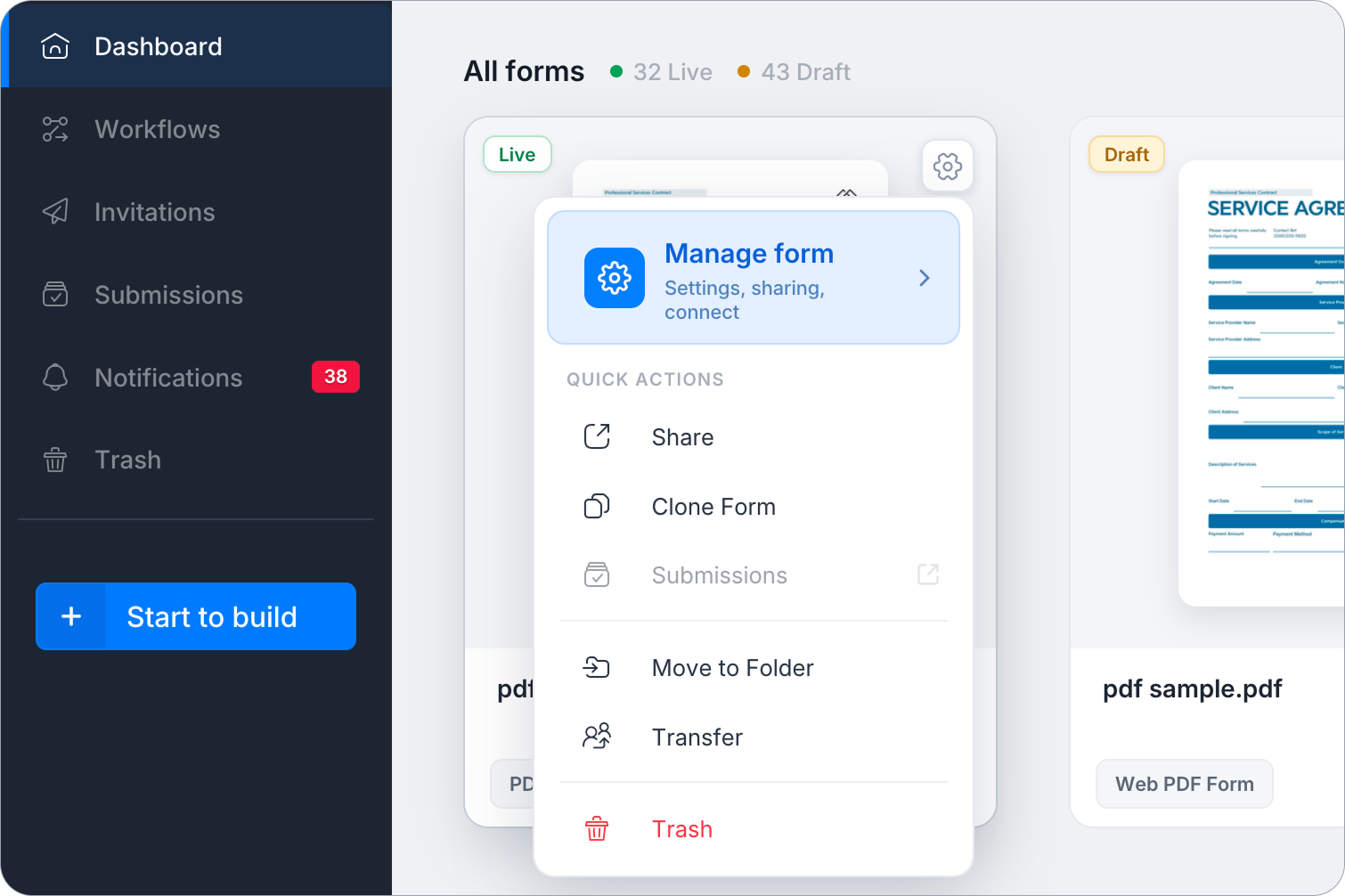
On the Dashboard, hover over the desired form, click the Settings (gear icon) at the top right, then click Manage Form.
-
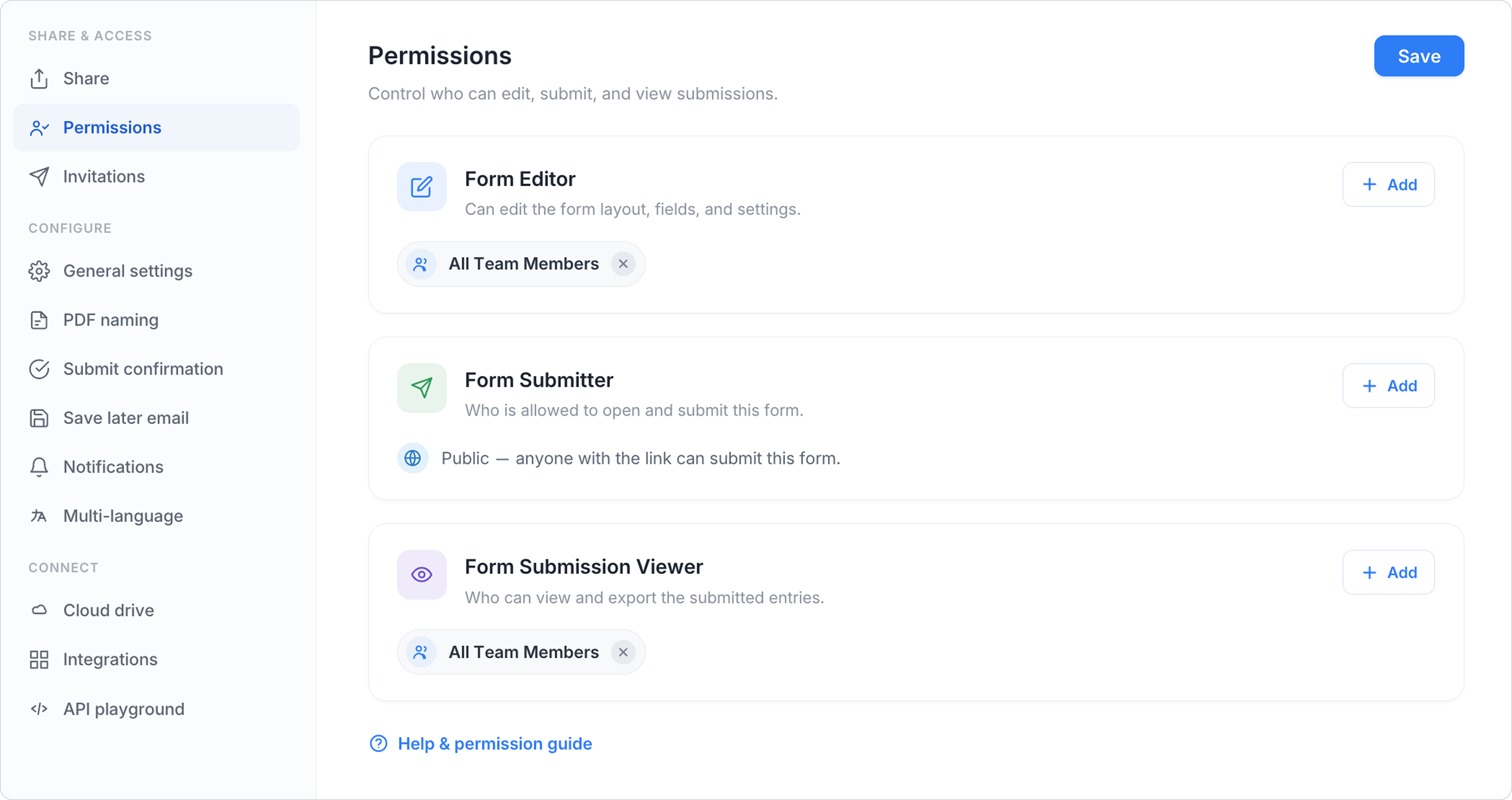
In the left-hand navigation, under Share & access, click Permissions.
-
On the Permissions page, manage each type of permission:
-
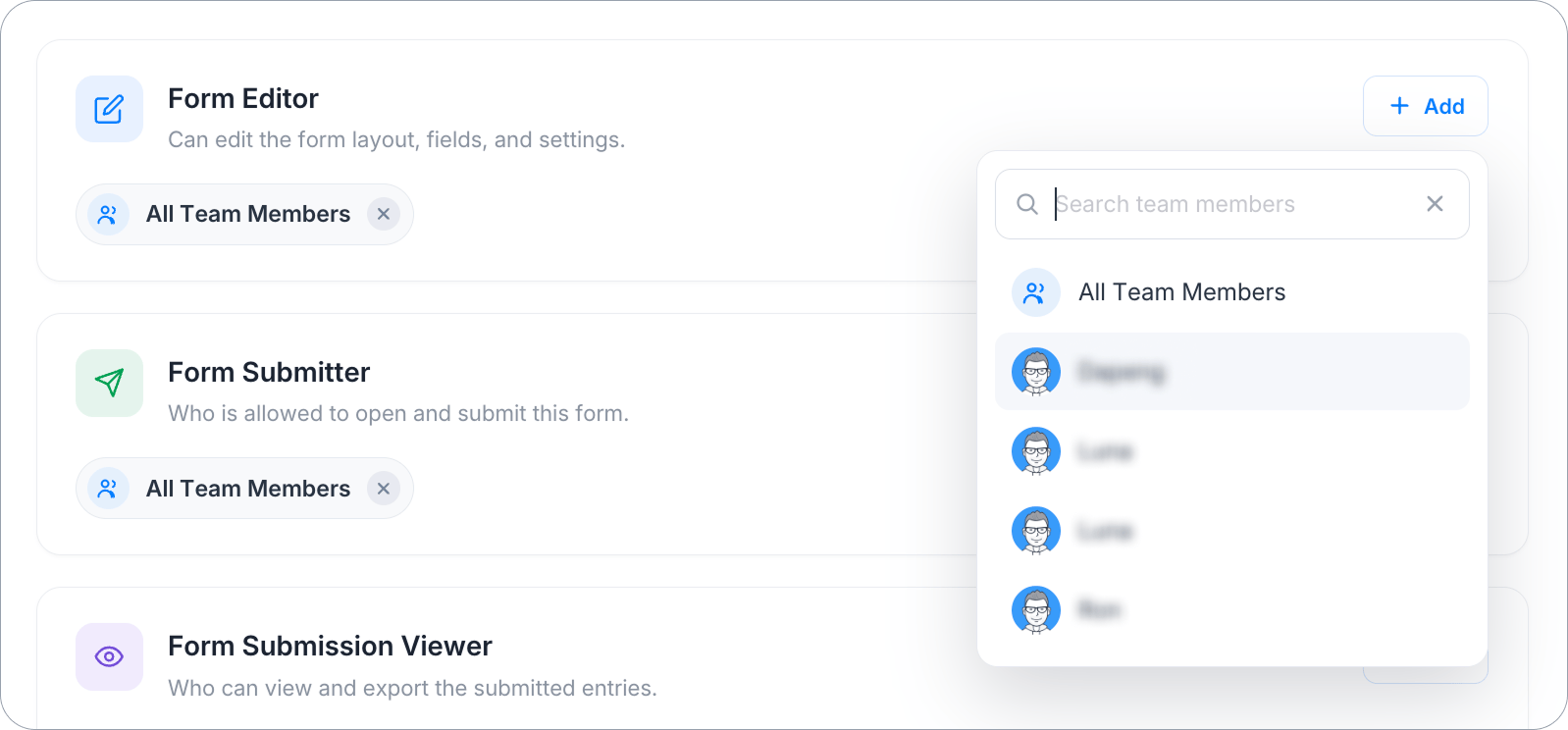
To add permission: Click the + Add button for the relevant permission type, then select a member from the dropdown.
-
To remove permission: Hover over the team member’s name and click the X button that appears.
-
-
After making the desired changes, click Save to save your settings.
Manage permissions across all forms (Team Admin only)
If a form ends up with no Editor who can fix its permissions (for example, its only remaining editors are no longer reachable), a Team Admin doesn’t need Form Editor access to that specific form to step in. Admins can open and fix permissions on any form on the team from one place:
-
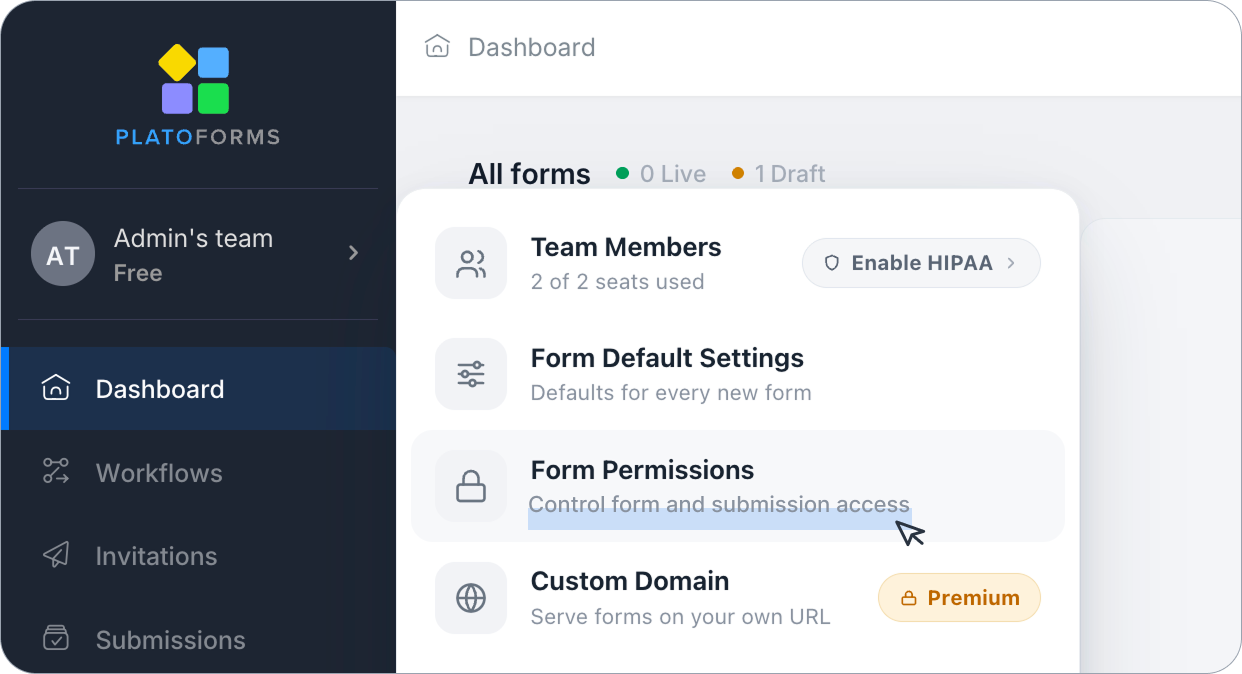
Click your team name at the top of the left navigation.
-
Select Form Permissions.
-
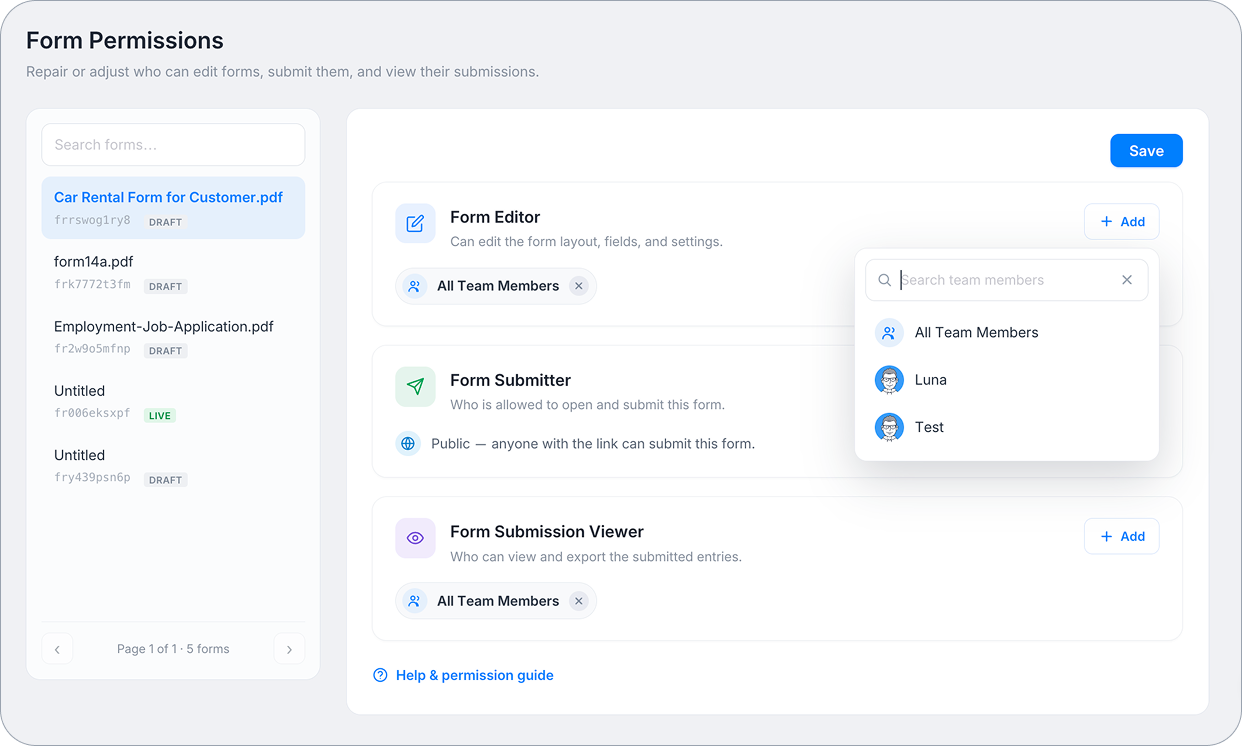
Search for and select the form you want to fix from the list on the left, then manage its Form Editor, Form Submitter, and Form Submission Viewer settings the same way as above.
-
Click Save.
This is the same three-permission model as the per-form Permissions page: the difference is that it works across every form on the team, not just the forms you already have Editor access to.
If you’re not a Team Admin
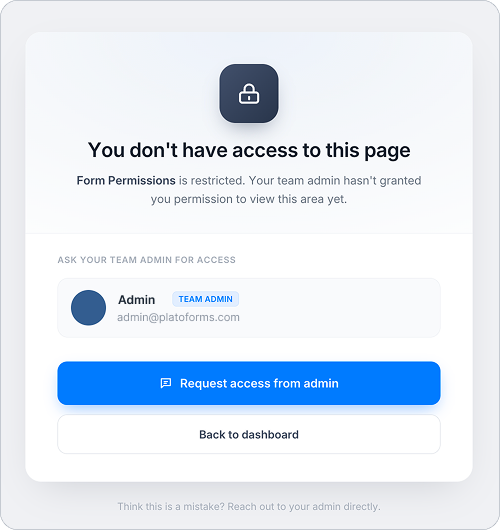
Team members without admin rights will see Form Permissions locked in the team menu. Clicking it shows who your Team Admin is and lets you send a one-click Request access from admin. The button updates to Access request sent, and you can send it again if you don’t hear back, or reach out to your admin directly.
Granting access (for Team Admins)
When a member clicks Request access from admin, you’ll get an email notification with a direct link to the Team page: click through, then follow the steps below to grant access. (You can also grant access proactively, without waiting for a request.)
Display names and team names can be identical or similar: confirm who’s who by email address, both in the notification and on the Team page.
Go to Team, find the member’s card, and click Manage access. This opens a list of independent toggles. Turn on Form permissions & defaults management to give that member access to the Form Permissions page. It also lets the member save Form Default Settings.
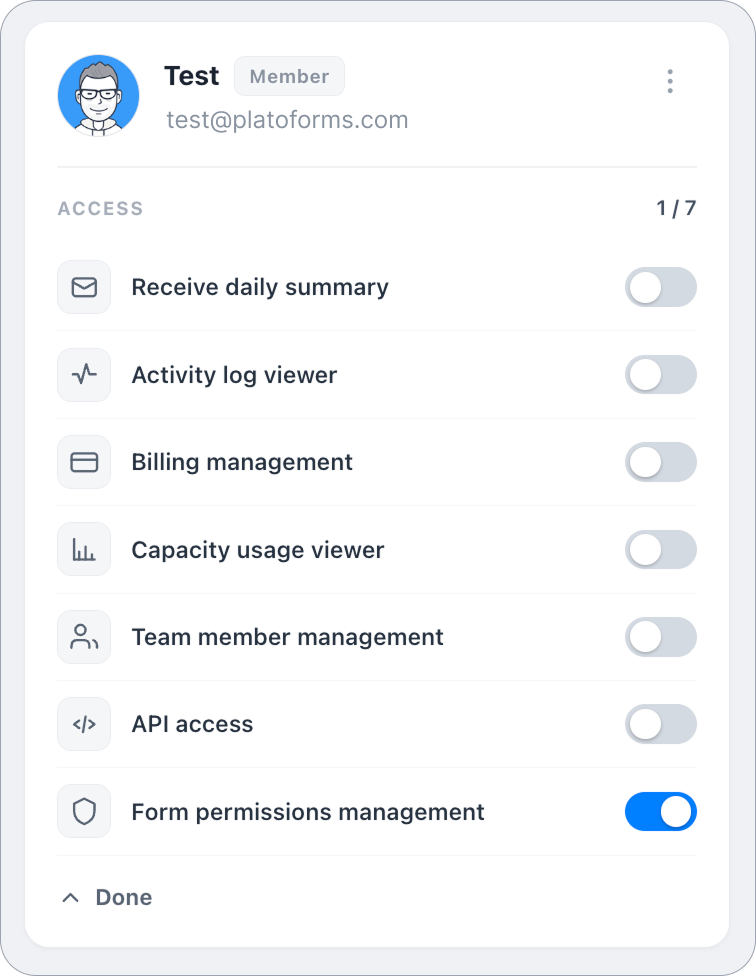
Turning this toggle on gives that member the same cross-form permission-editing power as a Team Admin: they’ll be able to change Form Editor, Form Submitter, and Form Submission Viewer settings on any form on the team, not just their own. Grant it deliberately, the same way you’d grant admin-level access.
This same panel controls six other restricted areas, each as its own toggle: Receive daily summary, Activity log viewer, Billing management, Usage viewer, Team member management and API access. You can grant a member exactly the access they need without turning everything on at once.
- Usage viewer (and Billing management) also opens the Usage credit page with the balance. Only Billing management sees the saved card and can add credit or change its settings.
- Team member management also covers Custom Domain and Email Domain Verification.
Granted permissions also show up as tags directly on each member’s card on the Team page, so you can see who has access to what at a glance without opening Manage access for every member.
Looking for team-level roles (Team Admin vs. Member) instead? See Can I have more than one Team Admin? or How to change the current Team Admin.