
Build a workflow
Tabs
This article walks through the workflow designer: creating a workflow, adding and connecting steps, the property panel, the checklist and publishing. The articles that follow go into each kind of step.
Before you begin
A form step needs a published form, so create and publish the forms first. Any form type works as a step: online PDF forms, web forms and master forms. When several people write into the same PDF, give each of them their own copy of the form with only their fields active. The quickest way is to clone the form with Reuse PDF File on, then hide or remove the fields that person does not fill in.
A car rental agreement: the customer’s form has the personal details, the salesperson’s form has the car and price fields, and the manager’s form has only the signature. All three use the same uploaded PDF.
Create a workflow
- In the left navigation, click Workflows.
- Click Create Workflow. The designer opens with an empty canvas and a default name; change the name at the top of the workflow panel on the right.
The workflow is saved as a Draft. Nothing can start a run until you publish it.
The designer
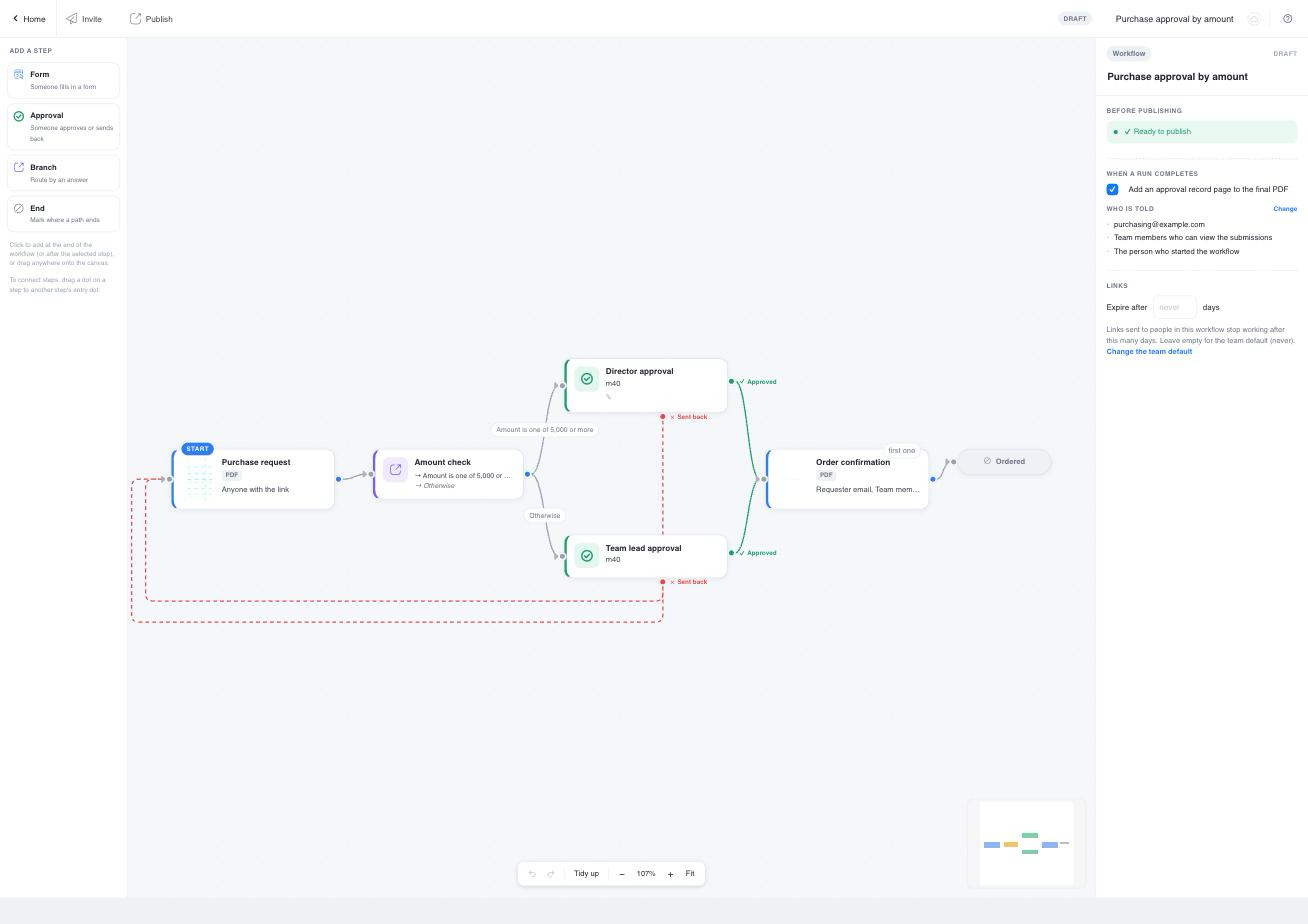
- Left: the step palette. Four kinds of step. Click one to add it after the selected step, or drag it anywhere onto the canvas.
- Middle: the canvas. Pan by dragging the background, zoom with the wheel or the − / + buttons, and click Fit to see everything. Tidy up lays the steps out left to right. Undo and redo are the two arrows at the bottom.
- Right: the property panel. Shows the selected step, the selected connection, or, when nothing is selected, the workflow itself with its checklist.
- Top bar: Invite, Share, Publish or Stop, and the workflow’s status.
Every change is saved as you make it. Saved appears in the top bar after each save; if the same workflow is open in another tab and changes there, the canvas reloads and tells you.
The four kinds of step
| Step | What it does | Read more |
|---|---|---|
| Form | Someone fills in a form. The first form step is the Start: its submission begins a run. | Form steps |
| Approval | Someone reviews what was submitted and clicks a decision button. It has two outgoing connections, Approved and Sent back. | Approvals |
| Branch | Sends the run down one path or another depending on answers given earlier. Nobody does anything at a branch. | Branches and parallel paths |
| End | Marks where a path ends. Optional: a path also ends at any step with nothing after it. Name an End step when different paths end differently, for example “Approved” and “Declined”. | Branches and parallel paths |
Add and connect steps
- Add a form step. Click Form in the palette, then pick the form in the panel on the right. The form’s cover, type and field count appear on the step. The first form you add becomes the start step, marked Start.
- Add what follows. With a step selected, click Form, Approval, Branch or End in the palette. The new step is placed after the selected one and connected to it.
- Connect steps by hand. Every step has an entry dot on its left and one or more exit dots on its right. Drag from an exit dot to another step’s entry dot. An approval has a green Approved dot and a red Sent back dot; a branch has one dot per path.
- Run steps at the same time. Drag a second connection out of the same exit dot. Both steps start together when the step before them is done. See Parallel paths.
- Send work back. Drag from an approval’s Sent back dot to an earlier form step. That form is reopened for editing when the approver sends it back. The connection is drawn as a red dashed line under the steps.
The canvas refuses connections that make no sense and tells you why: a loop that is not a send-back, a second connection into an End step, a send-back pointing at a step that comes later.
To remove a step, select it and click Delete step at the bottom of the panel. If the step had a step before and after it, the canvas offers to connect those two to each other. To remove a connection, click it and choose Delete connection.
The property panel
Select a step to see its tabs. The tabs depend on the kind of step:
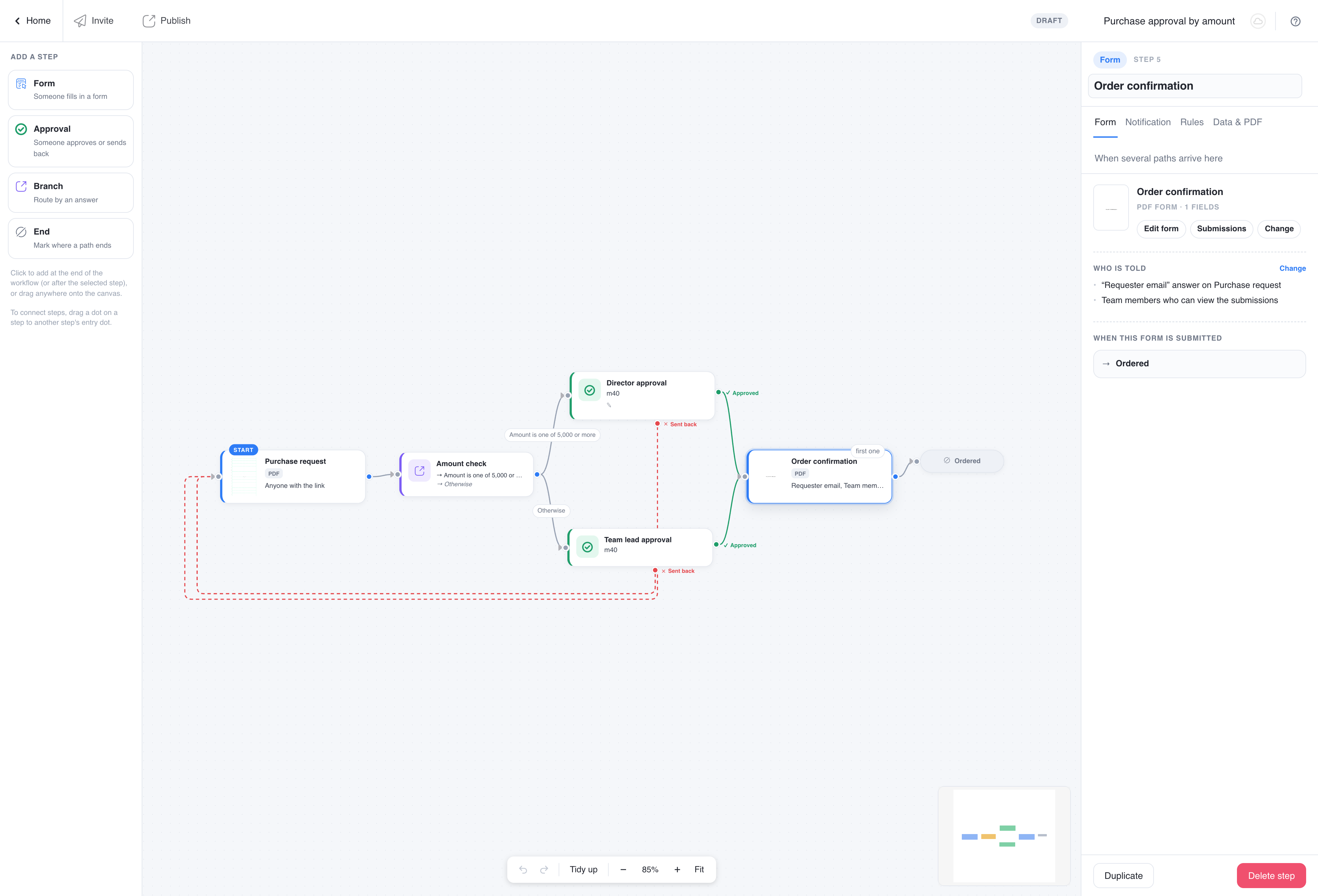
- Form step: Form, Notification, Rules and Data & PDF. The start step has no Notification or Rules tab, because nobody is emailed about it and it has no deadline: it is where runs begin. A step that several paths lead into gains a fifth tab, When several paths arrive here.
- Approval step: Approval, Notification, Decision emails and Rules.
- Branch step: Conditions.
- End step: a title.
- Connection: a label, and for a branch its rules.
Each step also has a Title. Give approvals distinct names, such as “Manager approval” and “Finance approval”: the names appear in emails, in the tracker and on the approval page.
The workflow panel and the checklist
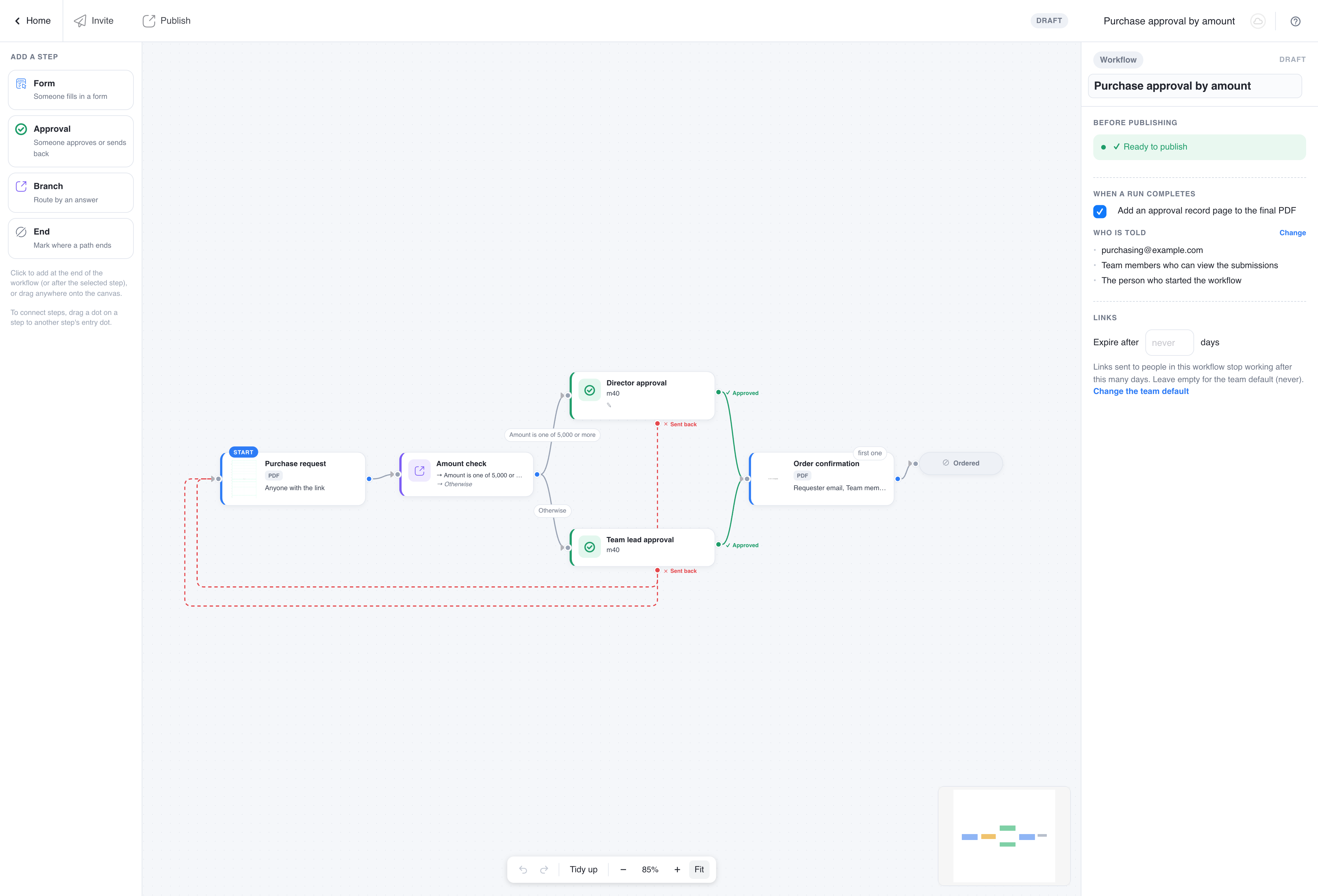
Click the canvas background to see the workflow panel. It holds:
- Before publishing: the checklist. Red items block publishing, for example a form step whose form is unpublished, an approval with no approver, a branch without an Otherwise path, or a step that nobody would be told about. Amber items are warnings you can publish with. Click an item to jump to the step it is about.
- When a run completes: whether to add an approval record page to the final PDF, and who is told when a run completes (the completion notification).
- Links: how long the links emailed to people stay valid. See Workflow links.
Publish
When the checklist reads Ready to publish, click Publish in the top bar. The workflow becomes Published: the shared link starts accepting submissions, invitations can go out, and the canvas becomes read-only.
To change a published workflow, click Stop, edit, then Publish again. While it is stopped no new run can start, but runs already in progress carry on. When you publish a changed workflow, runs that started on the previous version continue on that version; the designer tells you how many.
Workflow status
| Status | Meaning |
|---|---|
| Draft | Being edited. Nothing can start a run. |
| Published | Accepting submissions. The canvas is read-only until you click Stop. |
| Broken | One of the forms was archived, unpublished or deleted, so runs cannot continue. Publish the form again, or replace it on the step, and the workflow recovers by itself. |
Other actions on the Workflows page
Each workflow card offers Design, Track, Share, Invitation and Submissions, plus Rename, Clone and Delete. Cloning copies the canvas and every setting, which is the way to try a different version without touching the one that is live. Deleting a workflow does not delete its submissions.