
Workflows
Tabs
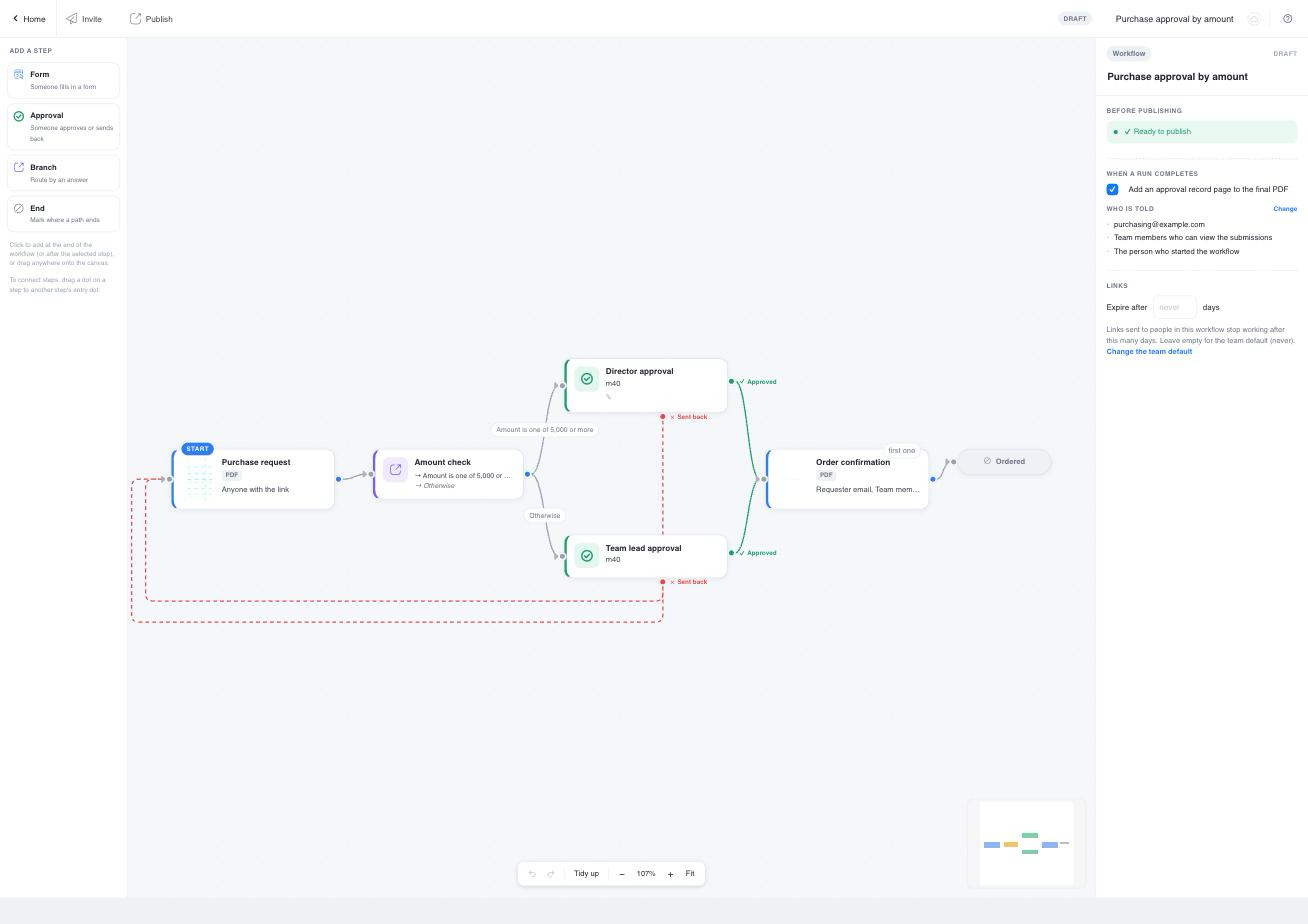
A Workflow passes a document through several people, one step at a time. A customer fills in a form, a manager approves it, a second person signs, and the result is one completed PDF. You draw the process on a canvas, decide who does each step and who is told when, and PlatoForms runs it: every submission starts a run, every person gets a link to their step, and the tracker shows where each run is.
In this chapter
- Build a workflow: the canvas, the four kinds of step, connecting them, the checklist and publishing.
- Form steps: pick the form, decide who fills it in, deadlines, reminders and how the PDF carries data from step to step.
- Approvals: who approves, decision buttons, sending work back, letting the approver sign, and the approval record page.
- Branches and parallel paths: route by an answer, run steps at the same time, and bring paths back together.
- Notifications and emails: who is told at each step and when a run completes, and what the emails contain.
- Share and start runs: publish, share the link, invite people, and how workflow links behave.
- Track runs: the tracker, nudging and reassigning, the final PDF and the submissions page.
- Examples: seven complete workflows, from a two-step signature to parallel approvals with sequential signing.
- Integrations and API: webhooks, the REST API, the MCP tools and Slack.
- Upgrading from classic workflows: what changed for workflows built before the canvas, and what was carried over for you.
What a workflow is made of
| Term | Meaning |
|---|---|
| Step | One box on the canvas. There are four kinds: a Form step (someone fills in a form), an Approval step (someone approves or sends back), a Branch step (the run takes a path depending on an answer) and an End step (marks where a path ends). |
| Connection | An arrow from one step to the next. An approval has two outgoing connections: Approved and Sent back. |
| Start | The first form step. A run starts when somebody submits it. |
| Run | One pass through the workflow, started by one submission of the start form. A workflow can have thousands of runs in flight. |
| Task | One step inside one run, handed to a person: “the manager’s approval on Jane’s application”. A form task ends with a submission; an approval task ends with a decision. |
| Path | A route through the canvas. A step with two outgoing arrows starts two paths at the same time; a step with two incoming arrows is where paths meet. |
Workflows are part of the paid plans. Your plan’s form allowance decides how many different forms a workflow can chain; approvals, branches and end steps do not count against it.
How a run moves
- Somebody submits the start form, from its shared link, an invitation, or your website.
- PlatoForms looks at what follows on the canvas and creates a task for each next step. The people named on that step get an email with a link to it.
- Each person opens their link, fills in their form or makes their decision, and the run moves on. A Sent back decision reopens an earlier form for editing; a Branch picks the path that matches the answers.
- When every path has reached its end, the run is complete: the completion notification goes out with the final PDF, and the run shows as completed in the tracker.
Each form step can print onto the PDF produced by the step before it, so a document that starts with the customer’s details ends up carrying the manager’s signature too. See Combine data across steps.
Where to find it
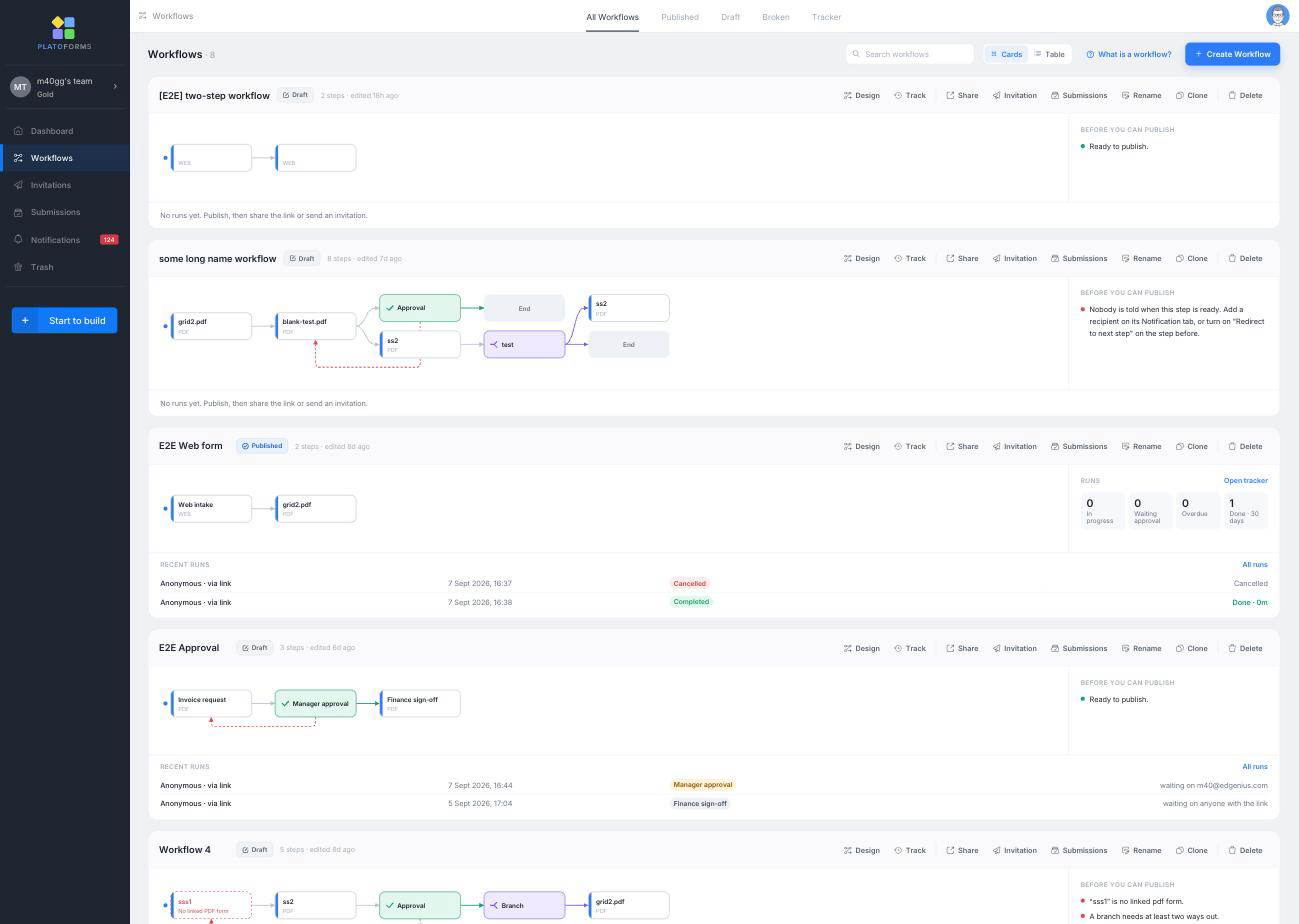
Click Workflows in the left navigation. The Workflows page lists every workflow with a small picture of its canvas, its status and its recent runs. From there you open the designer, the tracker, sharing and invitations.
Your workflows were converted automatically and keep working exactly as they did. Upgrading from classic workflows lists what changed and what was carried over.