








Publish and share
On this page
You need to publish your form before sharing it. Publishing makes it ready to share via URL, Embed Script, or QR code, so users can access it.
Publish your form
After finalizing your online form, click the Publish button in the builder’s top menu bar, to the right of the logo and Home area.
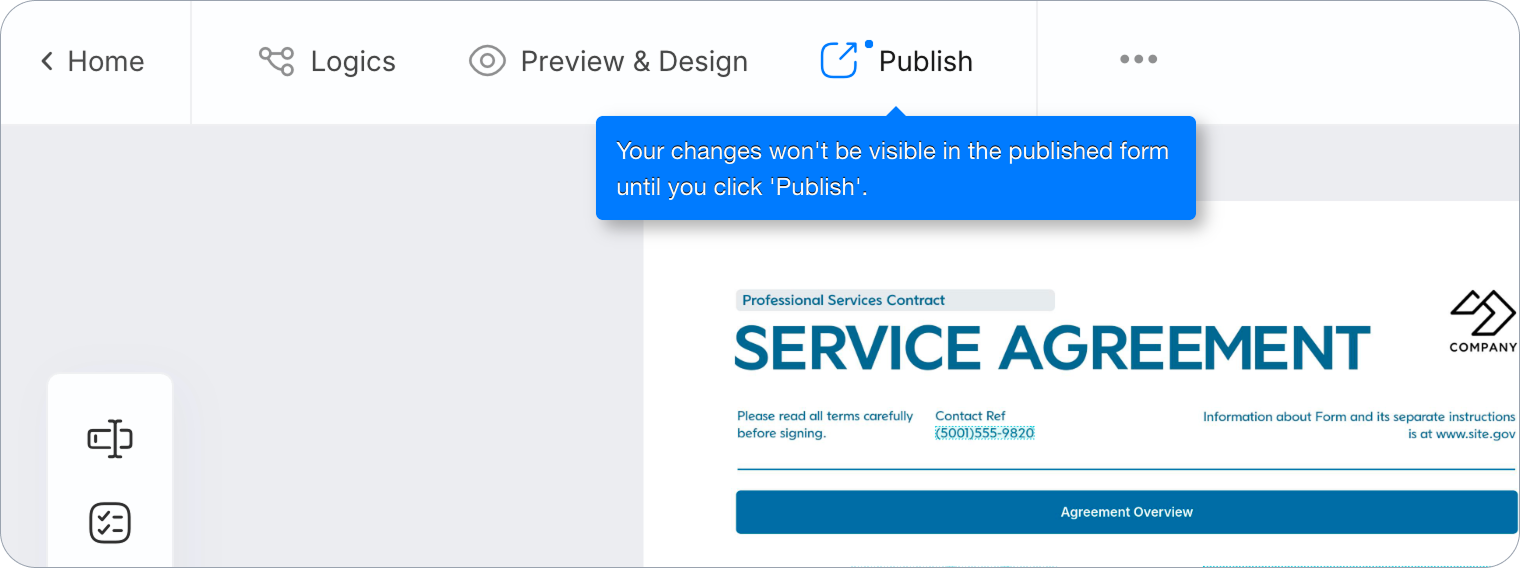
Changes you make in the builder after publishing reach the live form only when you click Publish again. A dot on Publish shows that there are unpublished changes. Publishing again keeps the same link and does not use another slot of your plan.
Your plan limits how many forms can be published at the same time (Free 1, Bronze 2, Silver 20, Gold 100). Drafts, forms in Trash and Master Forms do not count; each published linked form of a Master Form does. During the free trial there is no limit until you subscribe. The Usage page shows how many forms you have published.
Share your form
After publishing, you’ll have access to a Public URL, Embed Script, or QRCode: three easy ways to share your form. By default, anyone with the plain form link can view and complete the form. A link that ends in ?sid=... (what the browser’s address bar shows while someone fills the form) belongs to one entry and opens only for your team, so always share the plain link.
Public URL
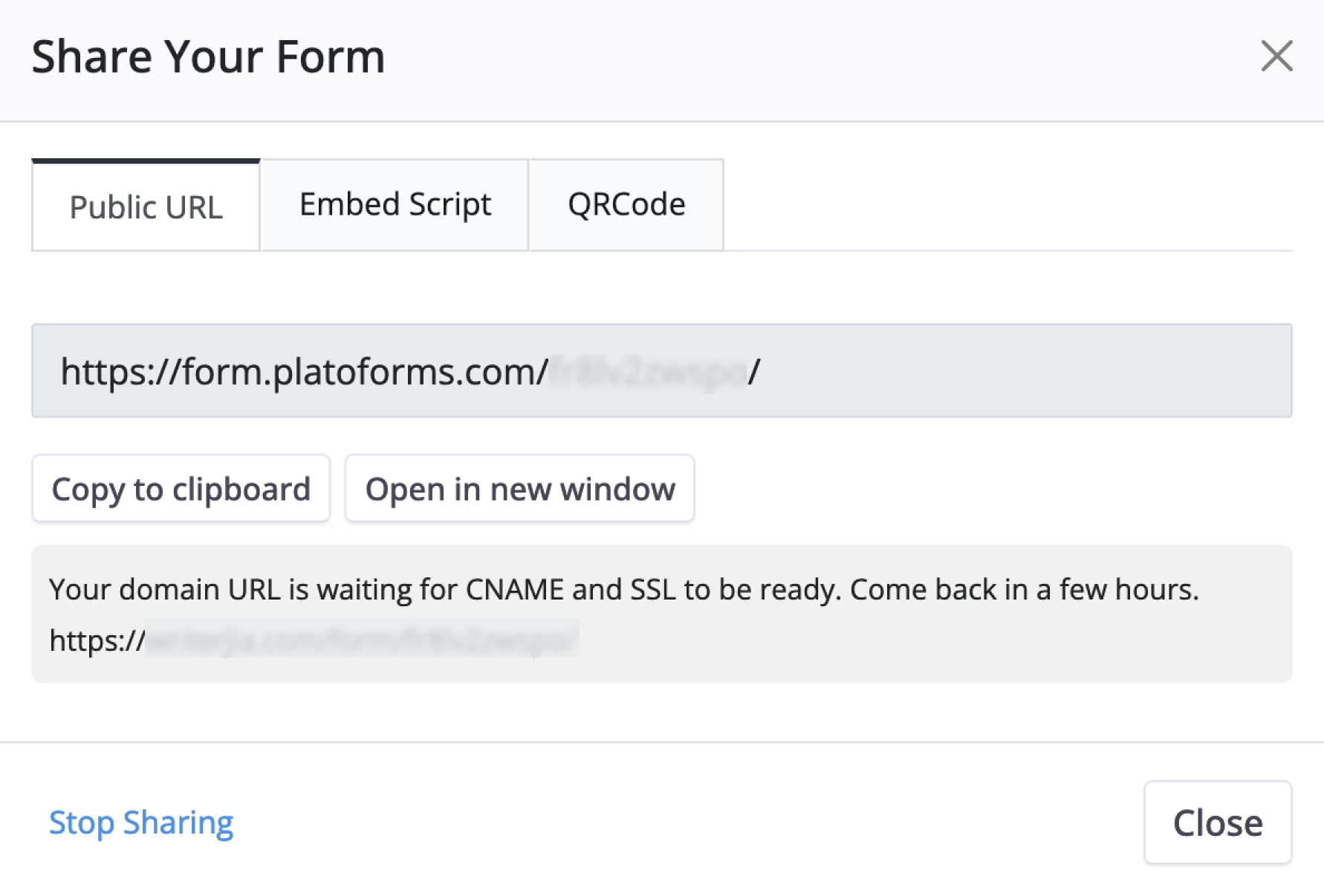
A shareable link that allows others to view and complete your form.
The Public URL tab shows your form’s shareable link. Use Copy to copy it, Open form to preview it, or Send via email to share it directly.
If you have set up a custom domain, the custom domain URL is shown at the top. The original PlatoForms URL is shown below under PlatoForms URL as a fallback, and both links open the same form. While the custom domain is set up but still waiting for its CNAME and SSL, the PlatoForms URL stays the main link and a note shows the future domain link. If no custom domain is configured, only the default PlatoForms URL is shown, with a box to set up your own domain (on a paid plan) or to upgrade (on the free plan or the free trial).
Voice Filling
For a published form, you can let authorized users complete it by speaking. Turn on Enable voice filling on the Share page (shown only to teams where voice filling is offered), choose who can use it and which languages they can speak, then share the voice link or QR code. See Fill out forms with Voice Filling for setup and usage instructions.
Embed Script
Add your form to your website with a code snippet, letting users fill it out without leaving your site. Choose from four embedding modes to fit your needs:
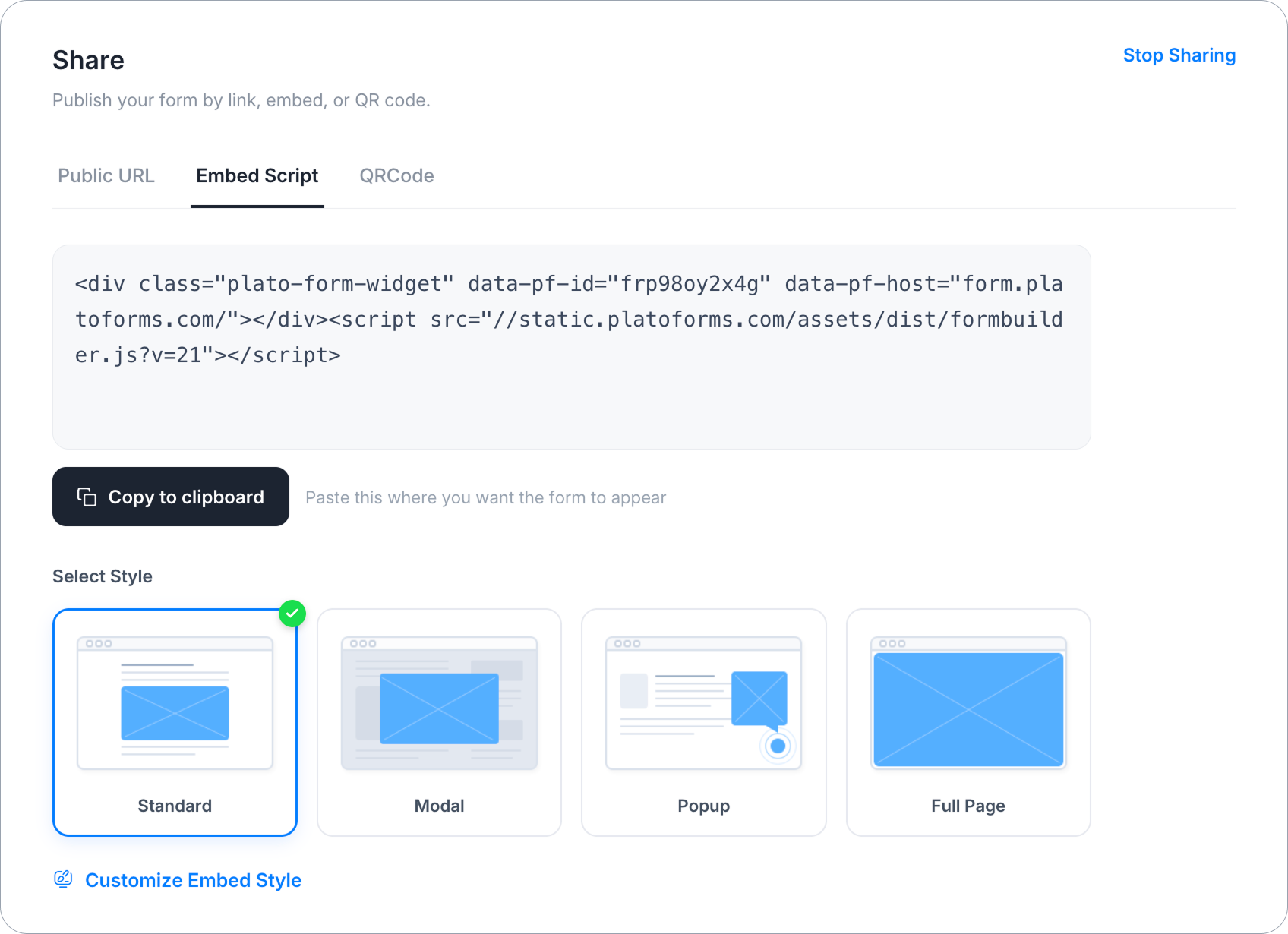
- Standard: Place the form directly on your webpage, perfect for contact forms or registrations.
- Modal: Open the form in a popup when clicking a button, ideal for “Get a Quote” or “Sign Up”. Customize the popup’s width, the button text, font size and weight, radius, spacing and four colors.
- Popup: Show the form in a floating window with an open/close button, great for subscriptions or feedback. Adjust radius, button size, and more.
- Full Page: Use the form as a full-page section, ideal for surveys or standalone forms.
To change the Modal or Popup options, click Customize Embed Style; the editor is titled Customize Embed Styles and previews the Modal and Popup styles. The code updates as soon as you change an option. A change reaches your website only when you copy the new code and paste it into your page. Save Styles only remembers the style for this form for next time, and Save as default saves it as your team’s default embed style.
For a comparison between the four embedding modes, see this FAQ. You can also refer to the video tutorial below for more details:
QRCode
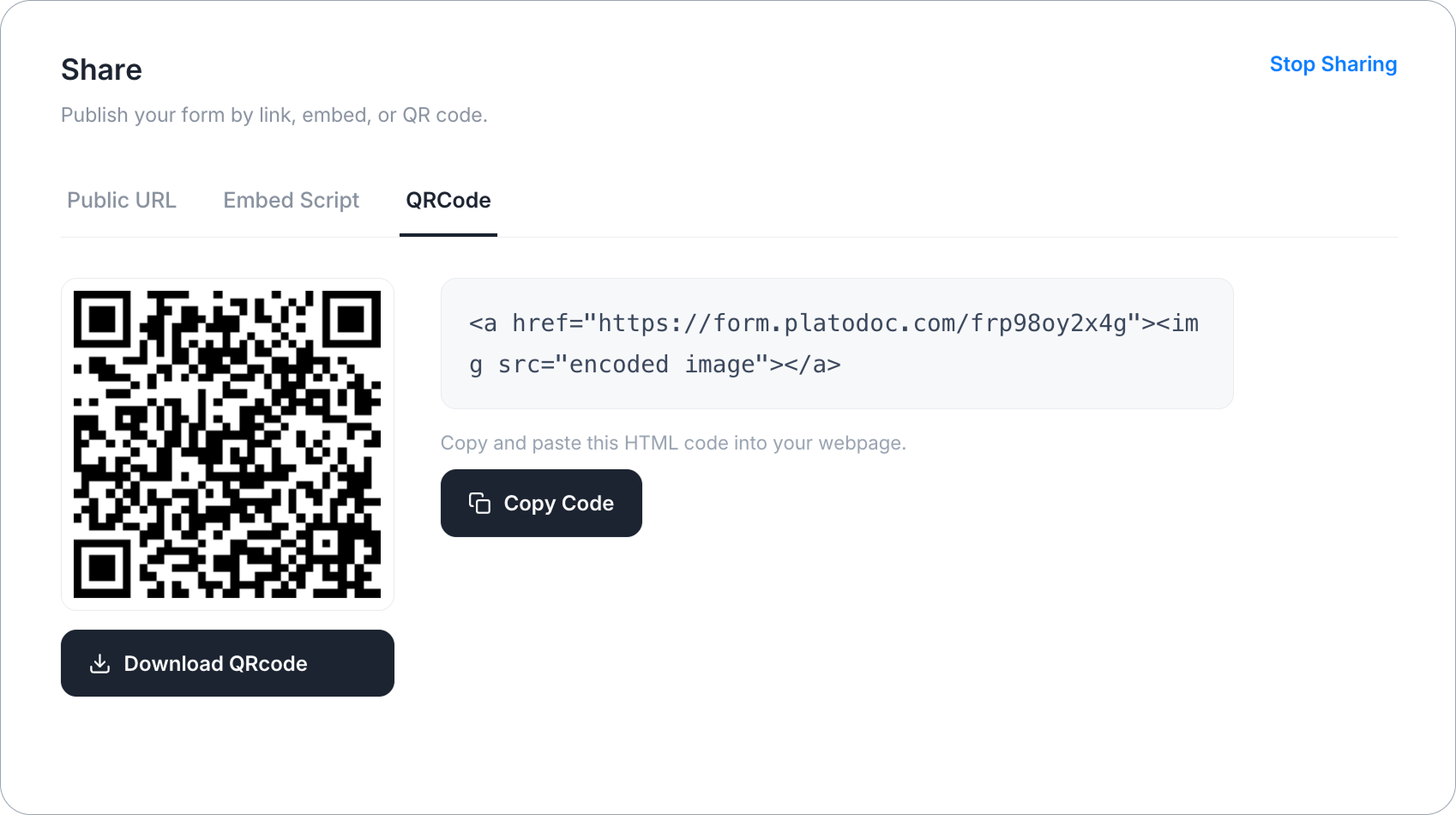
Display the QR code on your site or printed materials. Respondents scan it with their phone to open and complete the form.
Stop sharing your form
To take a published form offline, click Stop Sharing at the top right of the Share page, or in the Share Your Form window, and confirm. The form goes back to Draft:
- Its link, embeds and QR codes show an error page instead of the form, at once.
- Submissions, settings and the draft are kept. Publishing again later brings the same link back.
- The form no longer counts against your plan’s published-form limit.
- Workflows that use the form stop working until the form is published again.