
Form steps
Tabs
A Form step is a form that one person fills in. This article covers everything on a form step’s panel: the Form, Notification, Rules and Data & PDF tabs. For the emails themselves, see Notifications and emails.
Form tab
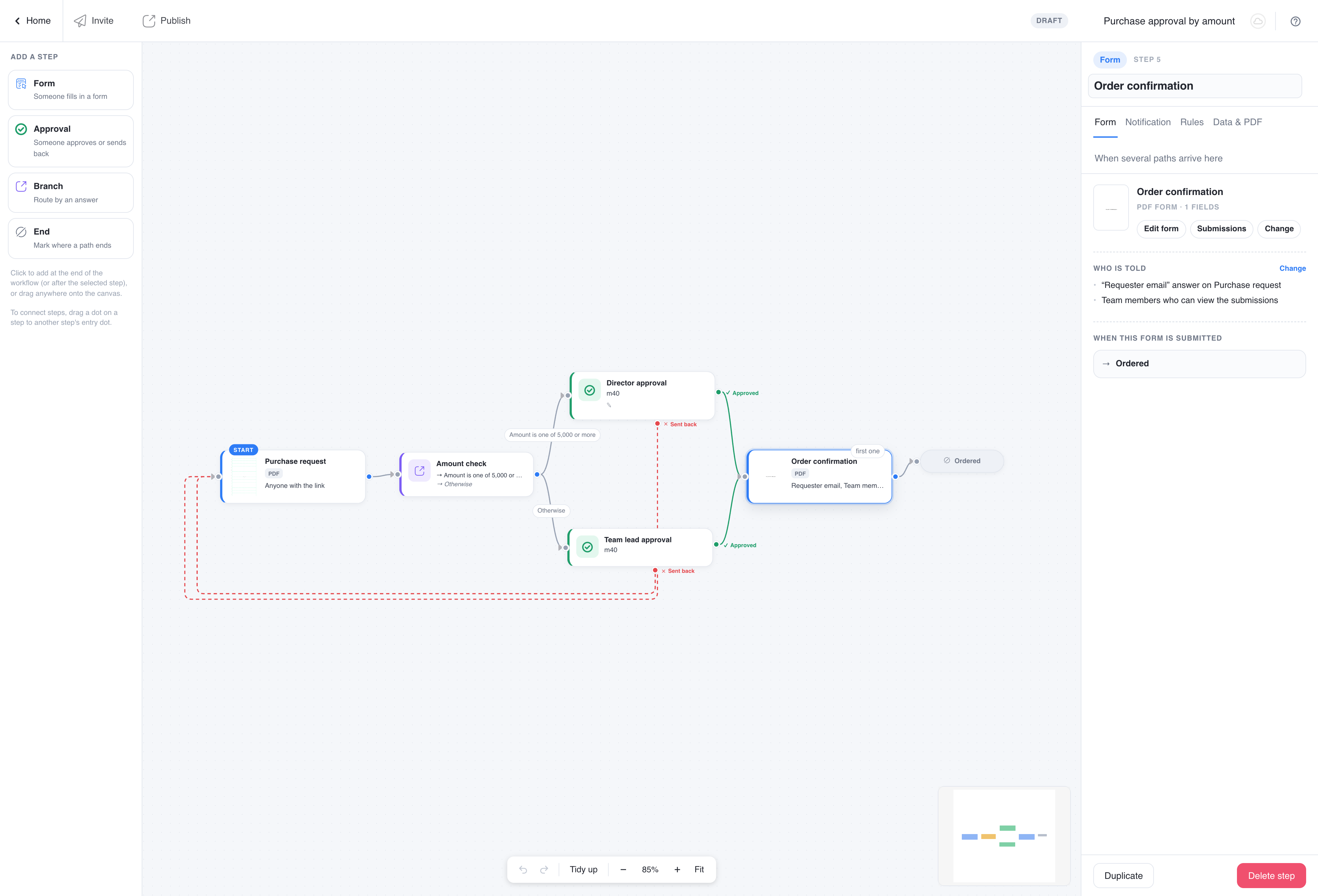
The form. The step shows the form’s cover, its type (PDF form, web form or master form) and how many fields it has. Edit form opens the form builder in a new tab, Submissions opens its submissions, and Change form swaps in another form. The form must be published; an unpublished or archived form shows as a red item in the checklist and marks the workflow Broken once it is live.
Who hears back (start step only). The person who submits the start form is the one decisions, send-backs and the completion email should reach. PlatoForms never guesses their address from the answers: choose the text field on the start form that holds their email, or leave it as None if runs are always started by invitation, in which case the invitee’s address is used. If the field is left unset and the workflow has approvals or send-backs, the checklist warns that people who start from the shared link will not hear back.
Who is told (every step after the start). A plain-words summary of the step’s Notification tab: the addresses, the answers from earlier steps, the person who started, the team members who can view submissions, or “the person who approved …” (such a step shows a green edge and a green ✓ Approver of “…” chip on the canvas; see Let the approver fill in a form). A step after the start that names nobody is a red checklist item, unless the step before it has Redirect to the next step after submitting switched on, in which case the person who submitted the previous form continues straight into this one.
When this form is submitted. One card per outgoing connection: which step comes next, who is told about it, and a link to that step’s Notification tab. The last form step shows The run completes with the recipients of the completion notification. When the workflow has parallel paths, the run completes only once every path has finished.
Notification tab
Who receives the email that says this step is ready, what it says, and the reminders that follow. This is the same screen as a form’s own notification settings, so everything you know from there applies. See Step notifications.
Rules tab
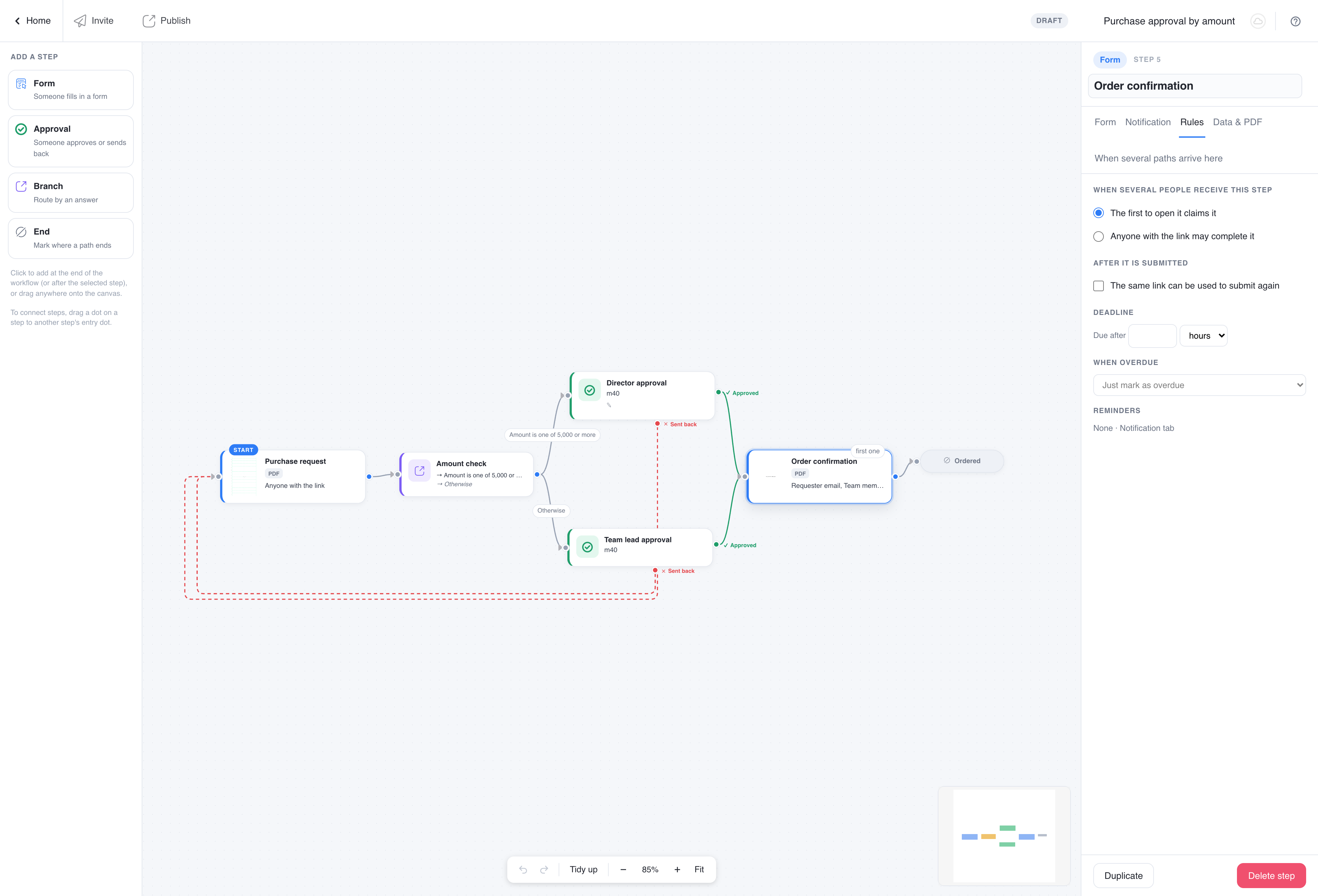
When several people receive this step. If the Notification tab names more than one person, they all get the same link.
- The first to open it claims it (default). Whoever opens the link first has the step; anyone else who opens it sees who has it and can take it over with Take it over.
- Anyone with the link may complete it. No claiming; the first submission completes the step.
After it is submitted. Once a form step has been submitted, its link normally shows “Submitted” and “This link is now closed.” Tick The same link can be used to submit again if the same person may need to submit this form more than once for the same run, for example several expense claims against one approved trip. The page then offers Submit another, each submission is recorded as its own task, and the steps that follow are created again for it. Whether a submitted form may be edited is decided by the form’s own confirmation page setting, not here.
Deadline. Due after a number of hours or days, counted from the moment the task is created. Leave it empty for no deadline. The tracker marks overdue tasks in red.
When overdue. What happens when the deadline passes:
- Just mark as overdue (default).
- Notify someone: email a team member or an address. You can add an address with Also email to the other options too.
- Reassign to someone: the task is handed to a team member, who gets a fresh link.
- Skip this step: the run continues without this form. Later steps that depend on this form’s answers, such as a branch or a PDF that combines data, run without them.
Reminders. Reminders are part of the step’s notification: open the Notification tab and add reminders there. The Rules tab shows a summary, for example “1 day, 3 days after assignment”.
Data & PDF tab
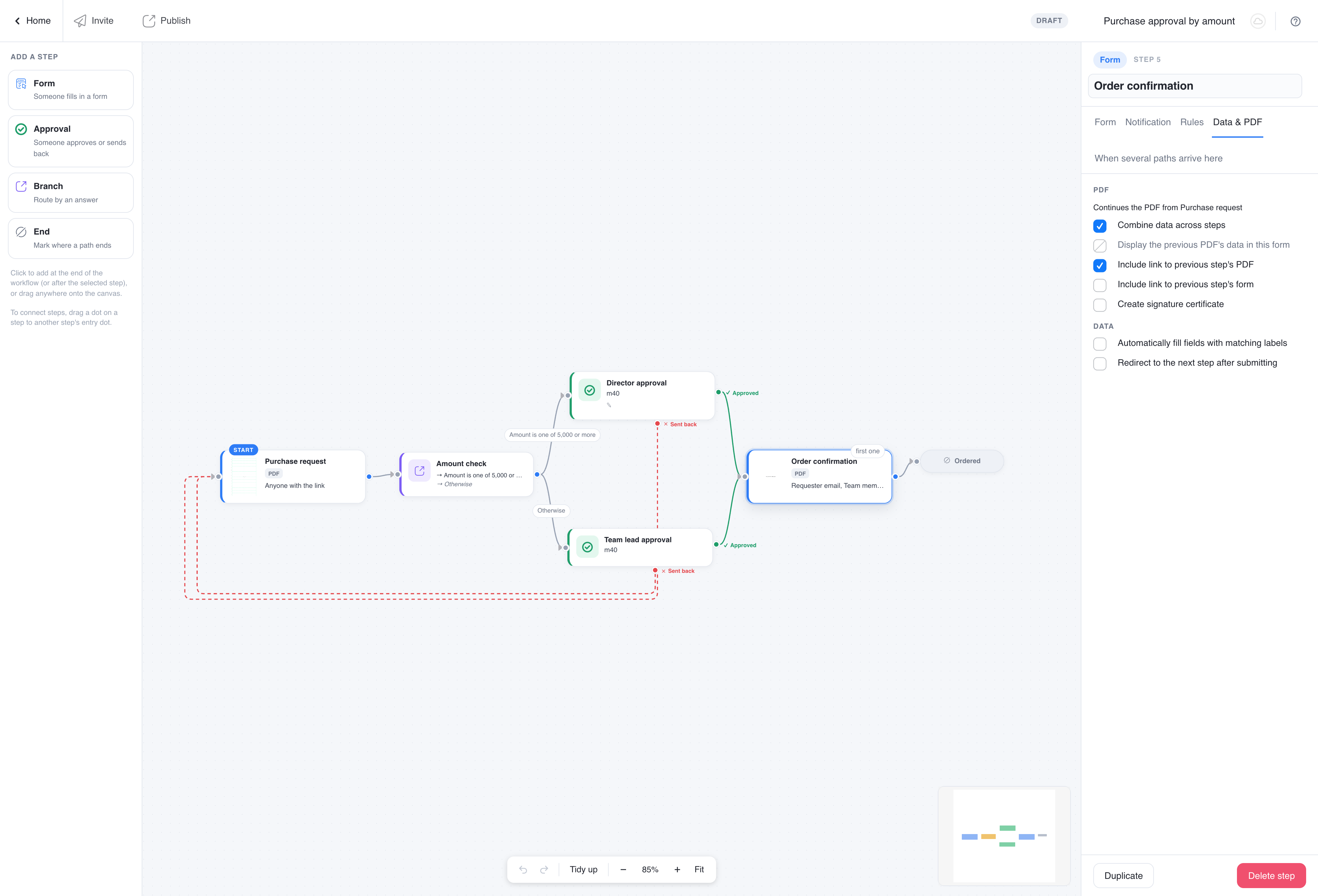
These options apply once a step comes before this one. They control how the PDF and the answers travel from step to step.
Combine data across steps. The step prints onto the PDF produced by the step before it instead of starting from a blank copy of its own template, so one document accumulates every step’s data. Switch it on when the steps share the same uploaded PDF; the panel says which step’s PDF this one continues from. Leave it off when the steps use different PDFs, otherwise the previous step’s document would be used as this step’s template. With a master form, Mapping PDF files in previous and current step lets you pair each PDF of the previous step with the PDF it continues in this step.
Display the previous PDF’s data in this form. PDF online forms only. Shows the data of the previous steps on this step’s PDF while the person fills it in, so a manager sees what they are signing.
Include link to previous step’s PDF. Adds a link at the bottom of the form to the PDF produced by the previous step. Useful when the form is a web form or when data is not combined.
Include link to previous step’s form. Adds a link that opens the previous step’s submission for editing. The person needs permission to submit that form; make the previous form’s Form Submitter permission Public if they are not team members.
Data
Automatically fill fields with matching labels. Fields on this form that have the same label as a field on the previous step are pre-filled with that step’s answer. Text, choice, dropdown and signature fields are copied; file uploads and photos are not, unless you also turn on Copy uploaded files with matching labels.
Two more options appear once automatic filling is on:
- Match display name first. When pre-filling, match fields by their display name before falling back to the label.
- Copy uploaded files with matching labels. Copies files uploaded in the previous step into this step’s file fields with the same label.
Create signature certificate. Produces a signature certificate for this step’s submission. The certificate names who signed and when, based on the address the workflow link was emailed to. When an approver is taken straight into their form after approving, that link still carries their address, so the certificate names them. For the start step, turn the certificate on in the invitation instead.
Redirect to the next step after submitting. Shown when a step follows this one. The person who submits this form is taken straight into the next form instead of seeing a thank-you page. Use it when the same person fills in two forms in a row.
What the person sees
The person receives an email for the step, opens its link and fills in the form. After submitting, the form’s own confirmation page appears. If they open the same link again later, it shows Submitted, the date and their address, and either This link is now closed or Submit another depending on the Rules tab. The link acts as the address it was emailed to, whatever PlatoForms account happens to be signed in on that computer.