



Challenge
The firm relied heavily on paper-based forms — both internally and with clients.
1. Attorney disclosure forms (Internal)
Every few weeks, all 70 attorneys were required to complete a disclosure form confirming whether they had done paid work for a specific client outside the firm.
- Printed and distributed on paper
- Yes / No answers circled by hand
- Written explanations required when "Yes"
- Slow collection and manual handling
2. Trust & Estates client intake (External)
The Trust & Estates department used a 12-page PDF intake form for clients preparing wills.
- Clients filled it out by hand
- Forms were mailed, dropped off, or completed in-office
- Staff scanned submissions manually
- Handwriting was often difficult to read
- Attorneys received information late, right before meetings
"People had to handwrite a 12-page form, mail it in or drop it off, then we had to scan it — and sometimes it was hard to read."
The process consumed time for clients, assistants, and attorneys, and created unnecessary friction before consultations even began.
PlatoForms Solution
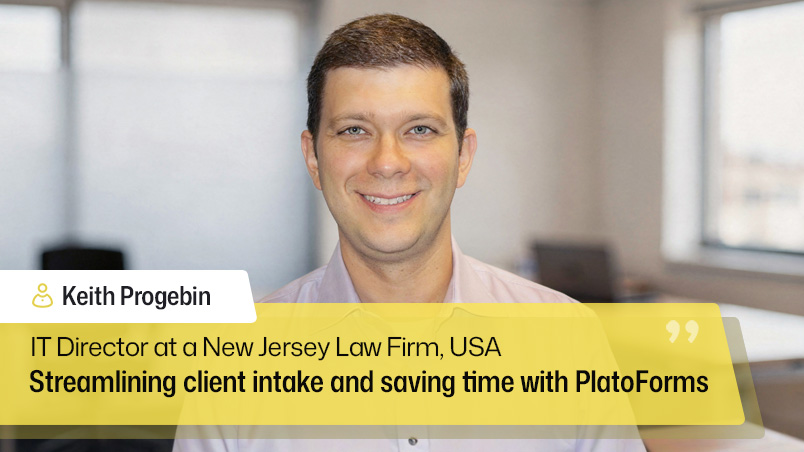
Keith's team moved both workflows into PlatoForms, replacing paper with online forms that required no user accounts or sign-ups.
Internal use: Attorney disclosure
- Paper disclosure forms were converted into online forms
- Forms are emailed to all attorneys
- Responses are collected digitally and centrally
Client-facing use: Trust & Estates intake
The 12-page PDF was converted into an online form using PlatoForms' PDF upload and form generation. The form is:
- Shared via the firm's website
- Sent directly by secretaries or attorneys
- Clients complete it at home, before their first meeting
"Most people wanted to fill it out online before they came in. Now they can submit it, then we call them to set up the meeting."
Results Achieved
The shift from paper to online forms created immediate time savings across the firm.
What changed:
- Clients complete forms in advance, on their own time
- Attorneys receive clean, readable, well-organized information
- Assistants no longer help clients fill out paperwork in person
- IT can update forms quickly without reprinting or redistribution
Submission volume
- ~10 submissions per week
- ~30 submissions per month for the Trust & Estates intake form
- Forms are sometimes submitted multiple times per day
"It's saving the client time, and it saves our attorneys time. Everything is done in advance and ready to go."
| Area | Before | After |
|---|---|---|
| Form Completion | Handwritten paper forms | Online form submission |
| Client Experience | In-office, mail, or scanning | Fill out at home |
| Readability | Handwriting issues | Clean, typed responses |
| Staff Effort | Manual collection & scanning | Automatic digital intake |
| Updates | Reprint & redistribute | Edit once, instantly live |
Features That Made the Difference
Keith highlighted several PlatoForms capabilities that were especially valuable:
- PDF → Online Form Conversion – Upload existing PDFs and turn them into fillable online forms
- Smart Field Formatting – Text wrapping and dynamic font resizing ensure all content fits cleanly
- Print-Ready Output – Submitted forms remain clear and readable when printed for records
- No Account Required for Clients – Anyone can submit a form without signing up or logging in
"It always comes out nice — never hard to read or difficult to use once it's submitted."
Why Not Google Forms?
Keith initially considered Google Forms but ruled it out.
- Requires users to have (or use) a Google account
- Adds friction for clients
- Not ideal for legal intake workflows
PlatoForms allowed the firm to keep the process simple and accessible for everyone.
"Not everyone wants to use a Google account. With PlatoForms, people just submit the form quickly and easily."
📖 Related Reading: Google Forms AI (Gemini): How It Works, Limitations, and What to Use Next – Explore why tools like PlatoForms are often a better fit for professional workflows.
Growing Adoption Across the Firm
After seeing the results in Trust & Estates, other departments began exploring similar digitization.
"Other legal departments want to do the same thing because they see how well it works."
The IT team is now actively identifying additional client-facing forms that can be moved into PlatoForms.
Overall Recommendation
Keith describes PlatoForms as:
"Very simple and very easy — but also very powerful."
For a law firm handling recurring disclosures and long, document-heavy client intake forms, PlatoForms became a practical way to modernize workflows without adding complexity.