
Branches and parallel paths
Tabs
Not every run needs the same steps. A Branch step sends a run one way or another depending on what was answered, and two connections out of one step run their steps at the same time. This article covers both, and what happens where paths meet again.
Branch steps
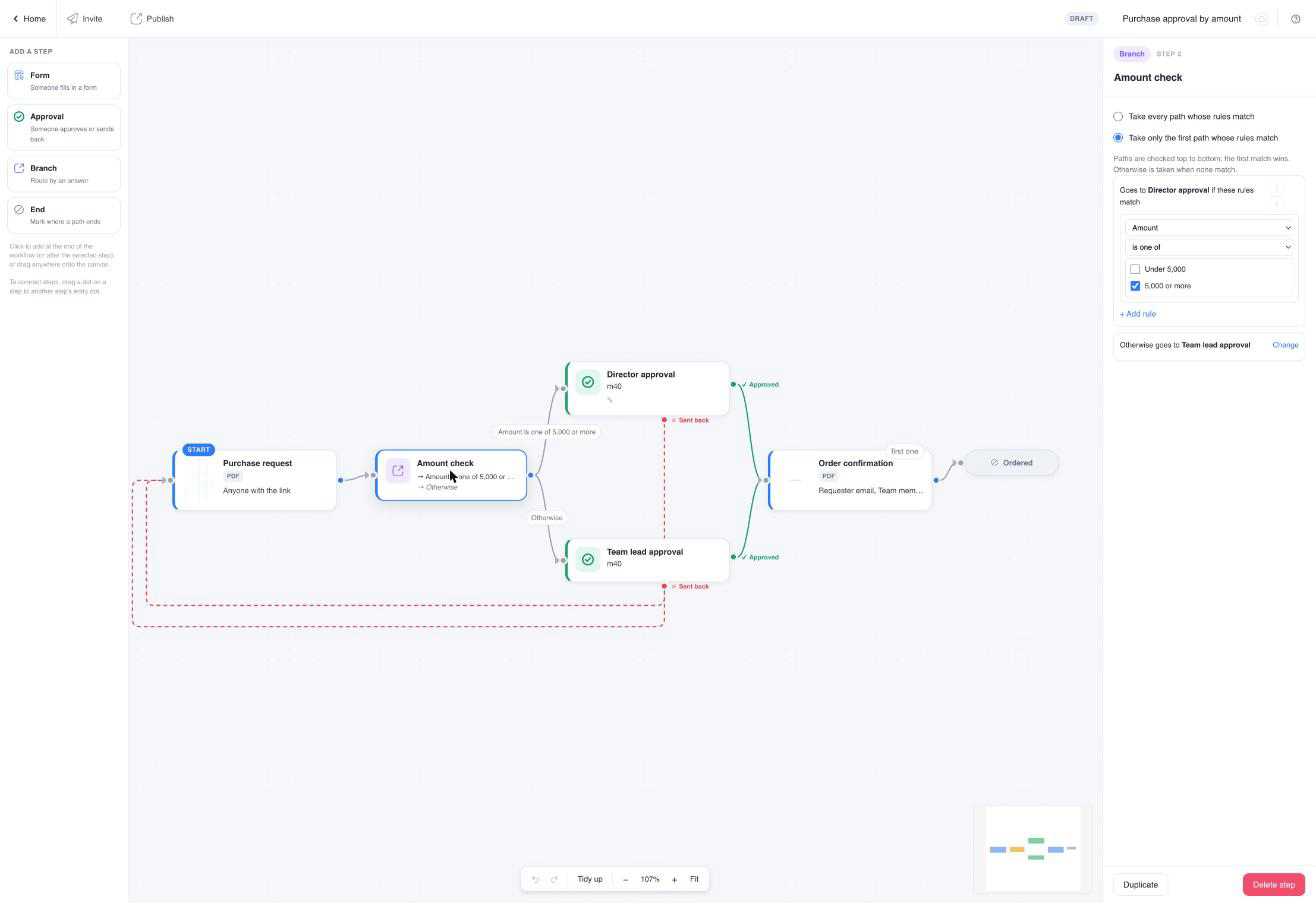
A Branch step routes; nobody does anything at it. Add it from the palette, connect it to the step before it, then draw one connection per possible path out of its exit dots. Each outgoing connection has its own rules; the one without rules is Otherwise, taken when nothing else matches. A branch needs at least two paths and exactly one Otherwise, or the checklist blocks publishing.
Rules
Select the branch to see its Conditions tab: one card per path, headed “Goes to X if these rules match”, and the Otherwise card at the bottom. Each rule is a field from an earlier step, a comparison and, where it makes sense, a value. Add rules with Add rule; with more than one rule choose All rules must match or Any rule matches.
The comparisons offered depend on the field, the same way they do in the form builder’s Logics:
| Field | Comparisons |
|---|---|
| Choice, dropdown, picture choice | is answered, is not answered, is, is not, is one of, is none of. The value is picked from the field’s own options. “Is” means exactly those options; “is one of” means any of them. |
| Text, email, URL and other typed fields | is answered, is not answered, is, is not, contains, does not contain, starts with, does not start with, ends with, does not end with, matches pattern. |
| Number, slider, rating | is answered, is not answered, is, is not, is greater than, is at least, is less than, is at most. |
| Date, time | is answered, is, is greater than, is at least, is less than, is at most. |
| Signature, image, file upload, table | is answered, is not answered. |
Text comparisons ignore case. Numbers compare as numbers. An unsigned signature counts as not answered. A field that was left empty, or that belongs to a step the run skipped, compares as empty, so a rule can never get a run stuck.
Order and mode
Paths are checked top to bottom and the first path whose rules match wins; move a card with the arrows to change the order. Switch to Take every path whose rules match when several paths should run at the same time, for example “notify Legal” and “notify Finance” both applying to a large contract. Otherwise is taken only when no path matches, in either mode.
The checklist flags a rule that reads a field from a later step, a comparison that does not fit the field, a rule with no value, and a choice that no longer exists on the form.
A purchase request: Amount is greater than 5000 goes to “Director approval”, Category is one of IT, Software goes to “IT review”, Otherwise goes straight to “Order”. Add the amount rule first so a large IT purchase still reaches the director.
Parallel paths
Drag two connections out of the same exit dot and both target steps start the moment the step before them is done. Each gets its own task and its own email. Use it when two people can work independently: a reference check and a background check, or two departments that each fill in their part.
Things to know about parallel paths:
- The run completes only when every path has finished. A form step that says The run completes on its Form tab means “when this path finishes”; other open paths still have to end.
- Each parallel form step starts from the PDF of the step before the split, unless the paths meet again at a join, so two form steps that both sign the same PDF on separate paths produce two documents. To collect two signatures in one document, sign in sequence after the approvals; the examples show how.
- A send-back on one path cancels the open tasks on the other paths of that run; when the reopened form is resubmitted, the paths start again.
Where paths meet
A step with two or more incoming connections is a join. Select it: its panel gains a tab, When several paths arrive here, with two choices:
- Wait for all of them (default): the step starts once every incoming path has reached it.
- Continue on the first one: the step starts as soon as any path arrives; the others are ignored when they arrive later.
A joined step continues the PDF and the answers of one incoming path only. Select the connection you want it to follow and tick Use this path’s PDF and answers as the base; the checklist warns when two incoming paths both carry a PDF of their own, because the other path’s document is not merged in.
End steps
An End step marks where a path ends. Any step with nothing after it also ends its path, so End steps are optional. Add one when it helps to read the canvas, or when paths end differently and you want to see which ending a run reached: name them “Approved” and “Declined”, and the tracker shows the name.